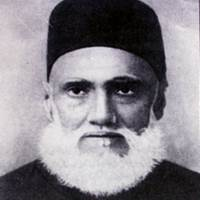
Profile of Ismail Merathi
Pen Name : 'Ismail'
Real Name : Maulvi Mohammad Ismail
Born : 12 Nov 1844 | Meerut, Uttar pradesh
Died : 01 Nov 1917 | Meerut, Uttar pradesh
āġhāz-e-ishq umr kā anjām ho gayā
nākāmiyoñ ke ġham meñ mirā kaam ho gayā
aaghaz-e-ishq umr ka anjam ho gaya
nakaamiyon ke gham mein mera kaam ho gaya
Identity: One of the architects of modern Urdu poetry (Nazm), eminent educationist, and children's writer
Maulvi Ismail Meeruthi was born on November 12, 1844, in the Mashaikhan locality (now known as Ismail Nagar) of Meerut, Uttar Pradesh. His father was Sheikh Peer Bakhsh. He received his initial education at home and pursued advanced Persian studies under Mirza Rahim Beg. Later, he obtained a teaching certificate from the Normal School (Teachers' Training School) in Meerut. During his education, he developed a special interest in geometry, physical sciences, and astronomy. After leaving an overseer course at Roorkee College unfinished, he joined the Department of Education. In 1867, he was appointed as a Persian teacher in Saharanpur, and in 1888, he became associated with the Central Normal School in Agra, from where he retired in 1899 and returned to Meerut.
Maulvi Ismail Meeruthi is widely recognized as one of the early pioneers and foundational builders of modern Urdu poetry. In the post-1857 era, when the Aligarh Movement sparked an environment of intellectual and ideological awakening, he turned literature into an effective medium for education and moral grooming. His contributions to compiling Urdu primers and textbooks hold fundamental importance. Although he is most famous for his children's literature, his literary persona is far more expansive and versatile.
He experimented extensively across various poetic forms, including ghazal, qasida, masnavi, rubai, and nazm. He made successful structural contributions through genres like Musallas, Murabba, Mukhammas, and Musamman, effectively paving the way for blank verse (Nazm-e-Mu'arra). Naturalism, moral training, national awakening, human empathy, and the practical realities of life are prominently reflected in his poetry.
His first collection of poems, titled "Reza-e-Jawaher", was published in 1885 and included beautifully rendered translations of English poems. He also compiled Persian language readers, authored a textbook on geography, and penned the memorable biography "Tazkira-e-Ghausia". In 1909, he established a girls' school in Meerut called "Madrasa-tul-Banat", which flourishes today as the Ismailia Degree Girls College. Furthermore, he served as the Vice President of the Meerut Muslim League and was an executive member of the advisory council of Anjuman Taraqqi Urdu. In recognition of his exemplary scholarly and literary services, the government of the time honored him with the title of "Khan Sahib".
Death: Maulvi Ismail Meeruthi passed away on November 1, 1917, in Meerut.
USEFUL LINKS : | https://en.wikipedia.org/wiki/Ismail_Merathi