 For any query/comment related to this ebook, please contact us at haidar.ali@rekhta.org
About The Author
Identity: A distinguished Islamic scholar, accomplished prose writer, linguist, the first Vice-Chancellor of Osmania University, and the addressee of Ghubar-e-Khatir
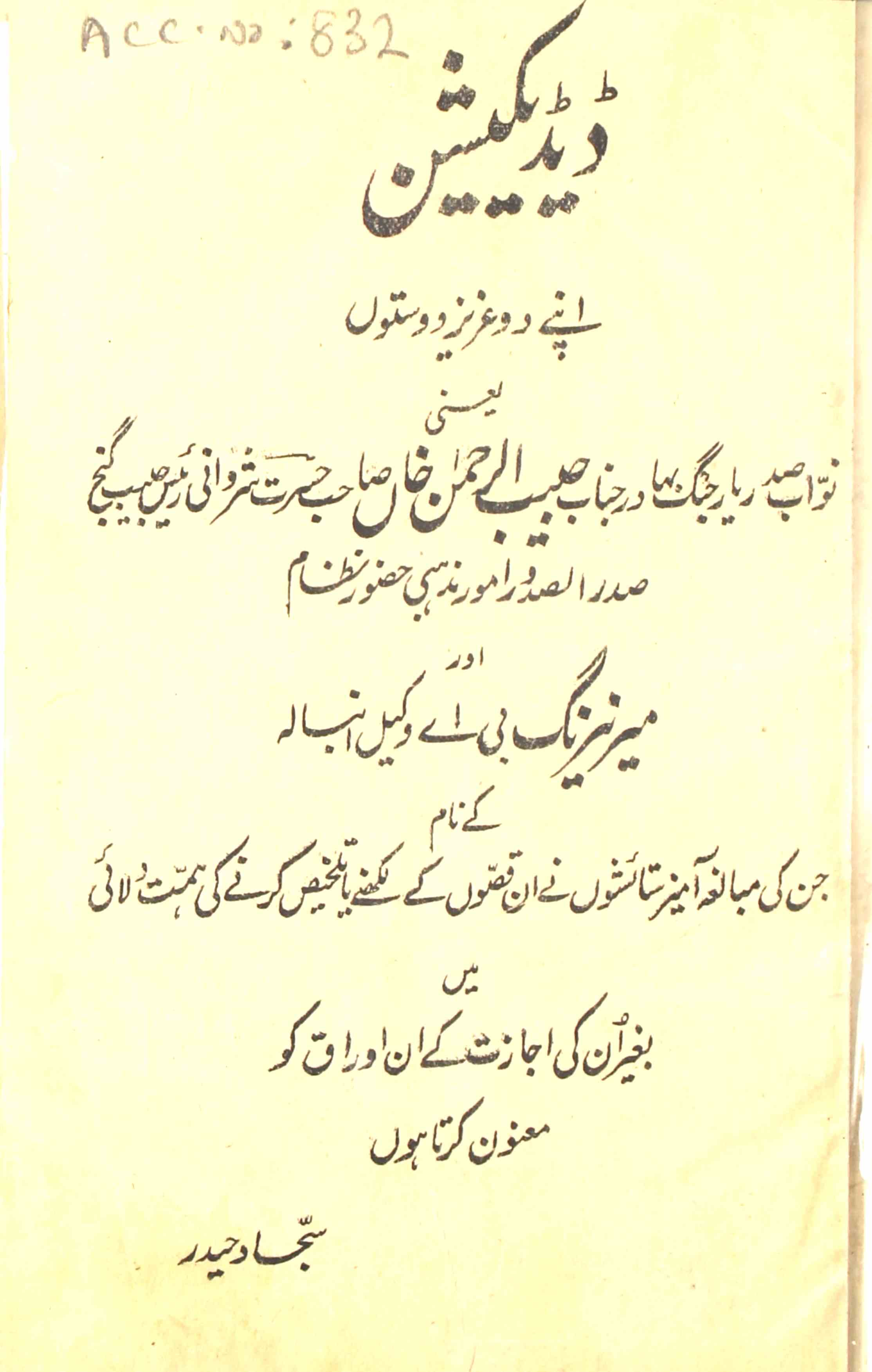
Nawab Sadr Yar Jang Maulana Habibur Rahman Khan Sherwani was born on 5 January 1867 in the village of Bhikam Pur near Aligarh, into a prominent Afghan family. He received his early education at Agra College and simultaneously completed his religious studies under Maulana Lutfullah Aligarhi. He was among the founding members of Nadwatul Ulama and also served there as a teacher.
His services extended from the princely state of Hyderabad to Aligarh:
Osmania University: He played a pivotal role in the establishment of Osmania University and served as its first Vice-Chancellor from 1918 to 1919.
Hyderabad State: From 1918, he served for thirteen years as the Minister for Religious Affairs (Sadr-us-Sudur). In 1922, the Nizam of Hyderabad conferred upon him the title “Nawab Sadr Yar Jang Bahadur.”
Aligarh Muslim University: After the death of Sir Syed Ahmad Khan, he served as the permanent secretary of the Muslim Educational Conference and played a significant role in elevating the Muhammadan College to university status. He was also the first Head of the Department of Theology at Aligarh.
He was a distinguished scholar of Urdu and Persian and a refined literary figure. His writings were deeply influenced by Allama Shibli Nomani and Maulana Hali.
Kutub Khana Ganj: He collected a vast number of rare books and manuscripts, which now form an important part of the Maulana Azad Library at Aligarh Muslim University.
He is also remembered in Urdu literature as the addressee of Maulana Abul Kalam Azad’s celebrated letters compiled in Ghubar-e-Khatir, written during Azad’s imprisonment in Ahmednagar Fort.
From a literary and historical perspective, he held a unique position. Maulana Ali Miyan Nadvi regarded him as a first-rank writer, noting that his prose had the ability to convey profound ideas with remarkable brevity. He was a historian with deep insight into classical sources and remained actively engaged with the evolving intellectual tradition. He was associated with the journal Al-Nadwa and also contributed to Al-Ma'arif. He is considered among the last great Persian-knowing scholars of India.
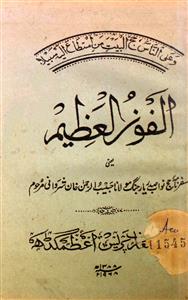
He authored around two dozen books, including Ulama-e-Salaf, Nabina Ulama, Seerat-us-Siddiq, Tazkira Babar, Al-Fawz al-Azim, Maqalat-e-Sherwani, and Karwan-e-Khayal. His scholarly contributions spanned theology, history, and literature. He also served as the head of Darul Musannefin and contributed significantly to the development of academic institutions.
Death: He passed away on Friday, 11 August 1950.
For any query/comment related to this ebook, please contact us at haidar.ali@rekhta.org