 For any query/comment related to this ebook, please contact us at haidar.ali@rekhta.org
About The Author
Identity: An eminent Iqbalian scholar, researcher, and philosophical interpreter of his literary works.
Yusuf Saleem Chishti is recognized in the Urdu world as a distinguished scholar, philosopher, and especially an expert in Iqbal studies. He rendered remarkable services in interpreting and explaining the works of Allama Iqbal and produced significant scholarly work on Sufism, philosophy, and comparative religion.
Yusuf Saleem Chishti was born on 2 May 1895 in Bareilly (Uttar Pradesh). His father, Muhammad Isa Khan, served in the police department, while his mother, Aziz Jahan Begum, was religiously inclined. He received his early education in Arabic, Persian, and Urdu at home.
He passed matriculation in 1912, F.A. in 1916, and earned a B.A. (Honours) in Philosophy from Allahabad University in 1918. He later completed an M.A. in Philosophy and also obtained a degree in theology. He studied the Vedas and Dharmashastra as well, which broadened his scope in comparative religion.
After completing his education, he joined the field of teaching. He served as a lecturer and professor in institutions in Kanpur and Lahore, and also taught at Murray College, Sialkot. He was appointed Principal of Ishaat-e-Islam College in Lahore and served there until 1943. After World War II, he worked in educational and advisory roles in Delhi and various princely states.
After the Partition of India, he migrated to Pakistan. He lived in Karachi and Lahore and devoted himself to writing and research. He was associated with scholarly institutions in Karachi, and his personal library was well known among scholars.
A major aspect of his scholarship is research in comparative religion and Sufism. His books Tarikh-e-Tasawwuf and The Admixture of Non-Islamic Ideas in Islamic Sufism are considered particularly important.
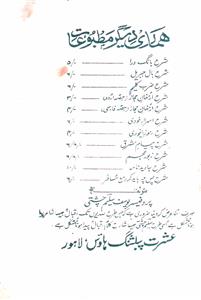
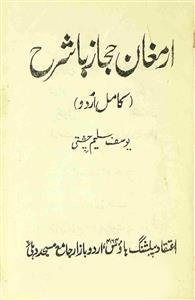
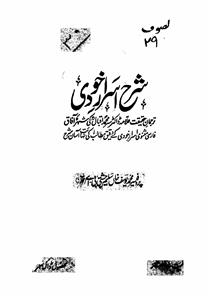
As an Iqbal scholar, he holds a very high stature. He had the privilege of spending a long time in the company of Allama Iqbal. He wrote detailed commentaries on all of Iqbal’s Urdu and Persian poetic works, including:Sharh-e-Bang-e-Dara, Sharh-e-Bal-e-Jibril, Sharh-e-Zarb-e-Kalim, Sharh-e-Armaghan-e-Hijaz, Sharh-e-Javed-Nama, Sharh-e-Zaboor-e-Ajam.
Besides Iqbal, he also produced commentaries and research on Ghalib and Akbar Allahabadi.
Around 25 of his books were published on various subjects, notably Sufism, philosophy, Iqbal studies, and literary commentary. Hundreds of his articles remain scattered in journals.
Due to his deep scholarship, critical insight, and intellectual honesty, he is counted among serious scholars. He used to call himself Iqbal’s “advocate,” reflecting his devotion and intellectual commitment.
Death: He passed away on 11 February 1984 in Lahore.
For any query/comment related to this ebook, please contact us at haidar.ali@rekhta.org