Khawaja Sag Parast
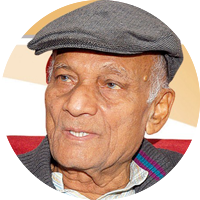
I have never visited the city of Gorakhpur in UP, nor did I ever feel the need to. I met Firaq Gorakhpuri, Majnun Gorakhpuri, and later Shamshad Nabi Saqi Faruqi, and I constantly read their writings. So, you could say that whatever is worth seeing and knowing in Gorakhpur—whatever is beautiful and captivating—I have practically seen it all. After all, what else is there to a city?
Yes, indeed! Saqi was born in Gorakhpur. He received his early education in Dhaka and completed his BA from Karachi University. He was studying for his MA in English when he left for London and started trying to get admission into the English Literature program at London University. The university administration told him, You will have to do your BA all over again here.
Saqi replied, I'll do it.
They said, Alright, but along with English, you will have to study both Greek and Latin. Only then will you receive a Bachelor of Arts degree.
Saqi retorted, What kind of absurdity is this? I can study Greek; it is the language of Aristotle... and Alexander the Great too. But I have a principled disagreement with Latin.
They asked, What disagreement do you have with Latin?
Saqi said, I just do. How do I explain it to you?
They insisted, Still, tell us something?
Saqi replied, Well, just consider the fact that Imperial Rome had a tradition of enslaving people, and they never granted their slaves the status of citizens. I am very angry about this, do you understand? I will not study Latin.
The London University officials said, In that case, we will not grant you admission.
Saqi replied, Who is even taking admission? I cannot compromise on my principles. And the matter ended right there. Consequently, whatever Saqi Faruqi studied from then on, he did so outside the bullying and bureaucracy of formal institutions.
Saqi Faruqi has spent a large part of his precious life in Gorakhpur, Dhaka, Karachi, and London. He often goes to the Austrian city of Vienna and stays there for days on end because his in-laws are in Vienna, including his father-in-law, who was involved in the Nazi movement during Hitler's time.
I have seen Saqi in both his homes, in Karachi and in London. In his Karachi home, unlike the rest of his family, he lived as if he were staying in a hotel. He even kept his books stacked in neat little piles, as if the moment he received marching orders, he would stuff them into bundles and set off. In contrast, in his London home, Saqi is firmly settled and has properly put down his roots. So much so that he has even built tombs for his late tortoise and his departed dog, Comrade, in his backyard, and he makes every visitor pay their respects to them.
My brother Jamal Ehsani and I had seen the dog Comrade while he was still alive. However, Jamal had left London before the dog's passing, so he couldn't see Comrade's grave, whereas yours truly had to stand in silence at Comrade's grave for two minutes as a precaution.
I would never have done such a thing, but Saqi had started barking, so I had no choice.
I don't know much about Saqi Faruqi's days of ignorance (or childhood) in Gorakhpur and Dhaka... I wasn't there at the time.
Regarding his Gorakhpur background, I only know that Saqi's grandfather, Khan Bahadur Khairat Nabi, was a retired Superintendent of Police and a very imposing man. He used to wear Sir Syed's favorite attire—a three-piece suit and a necktie—and because he was quite a handsome gentleman, he looked magnificent in his photograph. This portrait of Khan Bahadur hung in the main room of Saqi's rented 120-square-yard house in Karachi's Dastagir Society.
I remember the first time we went to Saqi's house (this is a story from 1958). In search of a ghazal by Yaas Yagana Changezi, he dragged us into his father's large room, where we saw this portrait for the first and last time. His father wasn't home, so Saqi was confident that he would succeed in recovering Yagana's ghazal.
The truth is, Saqi's late father, Dr. Iltifat Nabi, loved Yagana's poetry so much that he would search through Saqi's book collection and stacks of papers to retrieve any magazine or scrap of paper that had even a single couplet of Yagana written on it. He was a very busy man himself, so he didn't have the time to make copies of the ghazals. He would strictly tell Saqi, Look, let the ghazal stay with me for now; I'll return it once I've read it. This was an era when the youth of Karachi were actively discovering Yagana's poetry. A new couplet, or even a single line by Yagana, was treated as breaking news in youth circles. Yagana himself was still alive at the time. In the scholarly gatherings of Allama Rasheed Turabi in Karachi, Yagana's name reigned supreme; in other words, this was the golden age of Yagana's popularity among both the elders and the youth.
So, thanks to Yagana's ghazal, we got to see this magnificent color portrait of Khan Bahadur Khairat Nabi.
Oil paintings have always held a special significance in my childhood memories because my own father used to paint portraits. There was definitely something striking about the portrait of Saqi's esteemed grandfather, seeing which I exclaimed, Wow! Man, who is this magnificent gentleman?
Who? Where? Saqi asked, annoyed at being interrupted from his task. Oh, him? That's my grandfather, Mr. Khairat Nabi.
I was still under the spell of the portrait. I asked, What is this medal he's wearing on the chest of his coat, just like Sir Syed?
Where? Saqi said, turning toward the portrait. Oh, that? Hmph!
I didn't understand. I said, What do you mean by 'Oh, that' and 'Hmph!'? Is he not wearing a medal?
Oh yes, man, he... he received the title of Khan Bahadur. Hmph! Saqi opened his father's drawer and started shuffling through the papers again.
I disliked his dismissive attitude. Patting his shoulder, I said, Look here, listen to me! This is nothing to be ashamed of. Many grandsons would be proud of the fact that their grandfather received the title of Khan Bahadur. What is this nonsense you're going on about?
Pointing a finger at the portrait, Saqi said, I am unhappy with him... Why did he accept a title from the British?
Qazi Mahfooz interrupted Saqi, Well, Allama Iqbal also received the title of 'Sir', didn't he?
What do you think, I have any fewer complaints against Allama? I've only been letting it slide because of his poetry. The thing is, if my Khan Bahadur grandfather had composed even a single couplet like Iqbal, I could have forgiven his title, but he didn't write poetry at all. He turned to the portrait and said, Sorry, sir! I can't help it. Then he chirped, Oh! Here is the ghazal.
Saqi had finally found Yagana's ghazal in the drawer. We stepped out of his father's room and away from his grandfather's portrait.
The house number in Dastagir Colony, Federal B Area, was 100, where Saqi spent a long period of his creative life, his humiliations, his ecstasies, and his rise to prominence. In this house number 100 lived his mother, who would serve untimely tea and meals to Saqi's friends, have the bed in the outer room moved to spread mattresses on the floor, and essentially grant us nomadic poets permission to roost. May God elevate her ranks; she was a sort of welfare state in herself. Relying entirely on her, any of us could show up at Saqi's house at any time and find salvation.
Federal B Area was not yet fully populated. God knows if the buses stopped running here at ten or eleven o'clock. Saqi Faruqi's conscience as a host was absolutely untrustworthy. We lived in constant fear that at midnight, after reciting his poems, this man might just say goodbye and walk us to the door. We would be in deep trouble. We would have to walk for miles. The police might even pick us up. Although that never actually happened, a lingering fear remained in our hearts because some people had spread the rumor that Saqi had the hair of a beast in his eyes (an idiom meaning he lacked all human empathy). (This rumor later turned out to be false). However, an insider had also given us the good news: Whenever you reach Saqi's house, make sure to greet his mother in a loud voice; this is essential. Just let his mother know somehow that 'the kids' have arrived, and then she will handle everything herself. A mother is a mother, after all.
Just how crafty and deceptive a man Saqi was, we realized on our very first meeting—or rather, we couldn't quite figure it out on the first meeting, but when we visited the second time, we realized that what happened the first time...
But no. I will have to tell this story from the very beginning.
Where and who introduced the two of us for the first time, I no longer remember. I do remember this much, though: from nine in the morning until eight at night, we kept visiting different houses, having tea, eating meals, smoking cigarettes, and talking. We walked a lot, rode on buses, and at eight o'clock, somehow managed to reach Saqi's house in Dastagir Colony with him. At home, he fed us, served us tea, and then said, Now I am going to take you to sit in a place whose charm, freshness, and beauty you might find written about in books, but I swear to God, none of you will have ever experienced such charm, freshness, and beauty in your personal lives. Come on, all of you, follow me.
It was the month of August, during the dark, moonless nights of the lunar cycle. Back then, streetlights hadn't even been installed in Dastagir Colony. As we walked past the row of houses, an open field stretched out before us. Guiding us through the pitch darkness, Saqi Faruqi led us to some cement benches. Sit down and take deep breaths, he said. This is the easterly breeze, or perhaps the northerly wind. Yes, that makes sense—in our Sindh, the north wind is the harbinger of spring, the Utaradhi... Anyway, whatever it is. Right in front of us, as far as the eye can see—or, since you can't see it right now, for the next four furlongs—lies a lush green meadow. This is Dastagir Park. Just smell the air! It carries the fragrance of fresh grass, the verdant promise of growth... doesn't it? So, my friends, this is the place where I have sat and conceived most of my poetry. He then recited Hafiz’s famous verse about the beautiful streams and gardens of Shiraz, took a few deep breaths, and said, Let this freshness, this profound silence, and this green fragrance seep deep into your soul. Let it sink in completely. You bastards! You won't find such an intoxicating, green silence anywhere else in the city. Ahhh! Ha!
In the darkness, each of us sensed the presence of that well-watered, lush, and vibrant lawn and thoroughly enjoyed it. After sitting there for about an hour or so, we caught the last bus and headed back to our respective homes.
The memory of Saqi’s enviable, idyllic meadow lingered in our minds for the next three or four days.
The anticlimax—or rather, the rude awakening—occurred when three of us friends went to Saqi’s house to visit him. Intending to sit on those same benches, we walked past the row of houses, only to find a barren, dust-filled wasteland stretching as far as the eye could see—or at least for a good two furlongs. The bare, grassless ground was littered with gravel, and tiny dust devils spun dry twigs and dirt into miniature vortexes.
We glared at Saqi in sheer irritation. He simply said, Oh! Are you looking for the meadow? Then, with an air of profound wisdom, he added, That is only rolled out at night. As soon as morning breaks, the municipal workers roll it back up and take it away... Heh heh heh... How about that, boss?
Among our circle of friends back then, Qazi Mahfooz was affectionately known as the Scholar of the Age or Maulana Abul Kalam. Qazi Mahfooz had a unique talent: he could dress up the most trivial observation or piece of news in heavy scholarly robes, turning a simple intellectual exercise into a full-blown academic debate. For instance, if it was overcast and likely to drizzle, Qazi Mian would run a hand through his hair, tilt his head, and formally announce, The horizon is heavily overcast; therefore, the descent of precipitation is both inevitable and indispensable. If something could be said in complicated language, he simply refused to say it in plain words. Come what may, he would habitually tack on the phrase ala haza al-qiyas (and so on and so forth) to the end of his sentences. He used to claim—and perhaps still does—that adding ala haza al-qiyas grants a certain cognitive grounding to the corroboration of one's observations... or God knows what else.
So, in this highly formal and academic atmosphere, from 1954 to 1958, our dear Qazi Mahfooz would address us friends as Asad Sahib or Ihsan Sahib. In return, we naturally called him Mahfooz Sahib. What else could we do? Tit for tat.
Three days after the meadow incident, our relationship with Saqi was reaching a completely new plateau. Excuse me—I should say, in Qazi's style, it was ascending toward a state of formal configuration. We were sitting at Qazi Mahfooz’s house, eating semolina halwa, when Saqi’s face suddenly turned red. Stop! he barked.
We were in the middle of devouring the halwa. A few people pulled their hands back and paused, while others didn't care and kept eating. This enraged Saqi even further. Listen! he declared. There is no doubt my voice will carry all the way to the inner courtyard. Qazi’s mother and sister will be out there, so it’s best we all step out into the alley.
We knew exactly why he wanted to take us out into the alley.
Something had happened that made Saqi Faruqi feel an overwhelming urge to hurl profanities.
Some of us half-heartedly got up and went out into the street, while others refused to abandon the semolina halwa and stayed put in the room. Regardless, Saqi delivered a short speech to those who had gathered in the alley. He began,
You fortunate souls...! (Dear reader, please consider terms like 'fortunate souls,' 'wretched ones,' and 'sweet-talking parrots' as a polite compromise by the publisher. The actual expletives Saqi used to address us cannot possibly be put into print). He continued, You fortunate souls! You were wallowing in an abyss of degradation. I came, I saw, and you bastards, I decided to reform you...
Adopting the dramatic, oratorical style of the ancient Greeks, he began questioning us one by one: And what did I get in return?
Someone casually blurted out, Halwa... you got halwa, you bastard! This provoked Saqi on a deeply personal level. Fortunately, he wasn't the type to get into a physical brawl. After a while, he returned to normal and said:
You wretched ones! I see that to this day, like the most ignorant fools, you still call each other 'Asad Sahib,' 'Mahfooz Sahib,' and 'Irshad Sahib.' You’ve been friends for five or six years, and yet... Alas! This nonsense is still going on? Shame on you!
Trying to put an end to the matter, someone said, Oh great guide! If we don't use names, how else should we address each other? You tell us. Should we assign ourselves serial numbers and call each other by numbers? Number One?
Saqi slapped his forehead. You uncultured blockheads, you bastards, you sweet-talking parrots! Why would you use numbers? My children, your names are perfectly beautiful. By God, I have no issue with your names. But this 'Sahib' you tack onto the end—what is wrong with you? You wretched fools! Since when does this wretched veil of extreme formality exist between friends? You bastards! Friends are supposed to be confidants, completely open and uninhibited with one another. Do you have any idea? Our great poet Josh Malihabadi used to jump stark naked into Prince Moazzam or Mukarram Jah’s swimming pool along with his friends! And look at you bastards! A disgrace to your ancestors, wrapping each other in the suffocating blanket of 'Sahib.' A hundred thousand pities!
Saqi was on the verge of tears, trembling with anger as he stood in the alley. To calm him down, we consoled him and promised that we would never again humiliate and disgrace each other by using the word Sahib. From that day to this, we have kept our word—and all the credit goes to Saqi Sahib.
Now that he had appointed himself the parent of our little group, he decided to assert his dominance and awe us further. He decreed that we all had to attend an important meeting of the Writers' Guild, which was being graced by the renowned painter Faizi Rahamin and Atiya Begum Faizi.
We made excuses. Brother, what will we even do there? We aren't members of the Guild. Besides, some of us only started writing a couple of months ago. Others don't write at all; they just read. One of us doesn't even read—he just listens to your poetry verbally and doesn't even bother to praise it. So why on earth are you dragging us to a Guild meeting?
In response to our why, Saqi began listing his reasons: First of all, it is my order, so there is absolutely no room for argument. Secondly, I am a founding member of the Writers' Guild. I can bring whoever I want. Even if I walked into the meeting with Imam Bakhsh the Wrestler, no one would dare utter a word of objection.
Imam Bakhsh the Wrestler could walk into a federal cabinet meeting and no one would object, we retorted. Nobody wants to get their bones broken.
Don't be insolent, Saqi snapped. Listen to me. I want to show you all my pomp and glory. You people still haven't grasped my immense stature as a poet. I want you to come to the Guild and see my awe and grandeur with your own eyes.
We are already convinced, we replied. And as for your 'awe,' we've already heard that you grabbed a respected critic and senior poet by the collar and roughed him up over some argument.
That was a completely different matter, he defended himself. And the word 'respected' is highly debatable here. Furthermore, I did not rough him up. Whoever narrated the incident to you is an unreliable source and deserves to be beheaded. Tell me his name!
We aren't crazy, and we won't break our promise, we said. The narrator made us place our hands on his white hair and swear an oath that we would never reveal his identity to you.
Hearing this, Saqi looked pleased—perhaps because his terror was already being established among us without him even having to take us to the Guild.
Anyway, just to humor him further, we tagged along to the Guild meeting.
The hall was packed with founding members and their guests. Saqi didn't pull off any spectacular stunts at this gathering. Basking in the golden glow of his seniority and his reputation (both good and bad), he simply paraded us around the crowd. When he came face-to-face with Begum Atiya Faizi, he bowed with one hand on his stomach, adhering to the classic rules of chivalry, and said, Begum Sahiba! You are looking absolutely stunning.
Begum Atiya Faizi’s eyesight was failing her. She squinted through her kohl-lined eyes, trying to recognize his face, and then turned to the Secretary of the Guild. I don't recognize this boy. Who is he? He is very well-mannered.
The Secretary replied, Begum Sahiba, this is Saqi. The poet, Saqi Faruqi.
A poet! Atiya Begum repeated. Ah, now I remember. He is a fine poet. Brave and rebellious... but then again, this is the age for it.
Saqi laughed, soaking in the praise. I offer my respects...! You are looking even more beautiful now, Begum Sahiba. Hahaha.
Atiya Begum smiled, her eyes bright, and moved along.
Saqi came over to us and said, Did you see that, you rascals?
Later, indulging in a game of what if, Saqi kept trying to convince us that had he lived in the golden era of Maulana Shibli, Allama Iqbal, and Atiya Begum Faizee, he would have completely outshone both the great Allama and the esteemed Shams-ul-Ulema when it came to winning Atiya Begum's favor. In fact, it was quite possible that even her husband Faizee Rahamin's efforts would have gone to waste.
That was the kind of wicked fellow he was back in those days.
The second and final time he took us to the Writers' Guild office, the Pride of the Empire, Mr. Firdousi, was present there in person. Seeing him, Saqi warned us, Keep an eye out. A lot of things are going to be said today that might provoke me.
The most well-built among us replied to Saqi, You better watch yourself too, because I’ve been practicing how to grab a man by the scruff of his neck and drag him around without getting provoked.
Saqi Farooqi understood the gravity of the threat. Even in those days, his physique was nothing to be envious of.
When the meeting began, the Pride of the Nation, Mr. Hafeez Jalandhari, who was seated on the presiding sofa, started interrupting the proceedings with his usual short, seemingly harmless remarks. A report was being read out, which was likely boring the audience. Without necessarily encouraging the Pride of the Empire's remarks, people had started chuckling in hushed tones, whispering, coughing loudly, and yawning. The Pride of the Empire, Mr. Firdousi, assumed that this commotion was a reaction to his witty remarks, so he started throwing out comments even more rapidly. Saqi turned to us and said, I am gradually losing my temper. It is quite possible that this man's unwarranted and joyless interruptions will bring out my full, wrathful 'Saqi-esque' majesty. I am warning you now, don't say I didn't tell you.
Our well-built companion replied, 'No mortal can foresee his own demise'—and here, 'mortal' refers to you, Saqi Farooqi. So sit quietly. Don't cause any trouble.
Saqi fell silent. What could he possibly say in response to such an open threat?
Anyway, the report concluded. A prose writer read something out, and when the floor was opened for discussion on the piece, the very first person to rip it to shreds was Saqi Farooqi. Saqi’s aggressive assault was primarily meant to impress us. I can no longer recall who the poor writer was, but with every new critique, he would stare at Saqi in sheer astonishment, as if to say, Et tu, Brute?
Forgetting all loyalties, Saqi was hell-bent on slaughtering him.
Someone responded to Saqi's objections regarding the prose piece. Then, the Pride of the Empire, Mr. Firdousi, began to speak from the presiding sofa. We immediately knew that the threat of a breach of peace had escalated.
Firdousi began, When I was in Russia... He then went on to explain exactly how things were when he was in Russia.
Saqi interjected, I would like to ask my learned friend, the Pride of the Nation and the Country, Mr. Firdousi... et cetera, et cetera.
Saqi was calling him his friend, even though Firdousi was probably over sixty, while Saqi wasn't even fully twenty yet.
In response, Firdousi said, When I was in Russia... and once again clarified exactly how things were in Russia at that time.
Saqi nonchalantly tossed out a remark, the gist of which was that his learned friend Firdousi lived under the delusion that he could understand things, and that things could understand him.
Saqi had crossed the line. The Pride of the Empire, Mr. Firdousi, thundered, Young man! When I was in Russia...
Saqi didn't let him finish his sentence. He snapped, Stop! Mr. Firdousi, please stop! This gathering of brilliant writers and poets— Saqi swept his hand across the room like a broom, buttering up the entire audience.
He continued, This brilliant gathering is fed up to the back of its teeth—in fact, it is now boiling over—with the news, Mr. Firdousi, that you finally managed to visit Russia on the government's dime.
One of the sycophants raised his head from an adjacent sofa and said, Saqi! What kind of insolence is this?
Someone from behind us also chimed in with their sycophancy, Shame on you! Have some shame, mister!
A gentleman nearby clicked his tongue in disapproval and said, This treatment of the Pride of the Nation and the Empire, the Firdousi of our times, is intolerable. Mr. Farooqi, you must apologize.
A rebellion against Saqi was spreading.
Our well-built companion whispered in Saqi's ear, You noble idiot! You're going to get us killed too.
Another friend said, Drop dead already, get up and run away with your corpse, quickly. Move, you swine!
But Saqi—channeling the Farooqi lineage of his maternal family—now stood up tall, drawn to his full height. With all the aggression of purebred words, he delivered a continuous six-to-seven-minute speech to a breathless auditorium. The crux of his speech was that the embalmed corpses of the last World War had been imposed upon a living, dynamic, and mercurial new generation. He declared that while the youth represented the tender, budding aspirations of a newly blossomed land, this pack of jackals, nurtured by colonial toadies, was in charge. He lamented that stones and bricks were locked away while dogs roamed free; that Faiz Sahib had been banned from Radio Pakistan to the point where his name couldn't even be mentioned, while brainless, empty vessels kept rattling all the way from here to China. He exclaimed, What is this I am seeing? Ladies and gentlemen, I cannot remain a silent spectator to these wrongdoings and unjust favors. No!
From the ranks of the sycophants, someone played on the word wrongdoings and made a snide remark about Saqi's reckless immaturity. The Secretary of the Guild (or whatever his official title was) reminded Saqi that this was a literary gathering, and political discussions could not be held on this forum. We tugged at the sleeve of our host, Saqi Farooqi. Let's go...! What kind of mess have you dragged us into?
His eyes were gleaming, his head and neck held at a defiant angle. In a stage whisper—a whisper loud enough to carry across the room—he replied, You sweet-singing rascal! Can't you see a fierce battle is raging? If you came here to write poetry, then you better learn this too... learn how the money-changers are driven out of the temple of the Lord. Learn this right now.
But the Writers' Guild office was not the temple of the Lord, nor could the realms of poetry and literature be conquered through military invasions. Ultimately, Saqi Farooqi had to understand—and occasionally participate in—the rat race that permeates literature just as it does every other sphere of life. Perhaps he had already won a minor rat race before, having managed a trip to Dhaka on an airline ticket provided by the Guild. He had written a poem about it: row upon row of soft jute plants... True, he couldn't go to Russia or China. So, that particular anger remained firmly in place.
Later on, the literary maneuvers Saqi orchestrated regarding the Urdu Markaz, BCCI, or the Bangalore-based journal Soughaat, should be seen as the broken links in a chain forged by his deprivation of Russia and China, coupled with his sense of entitlement and high expectations. I am not defending him, but perhaps Saqi has remained a spoiled, eccentric child to this day, always demanding the moon to play with. Perhaps Mumtaz Hussain, Madni, Saleem Ahmed, Athar Nafees, and countless others—including yours truly—spoiled him rotten with our pampering. Anyway, let it be. Listen to another story.
Saqi used to tell us that once, during a grand convention of the Guild, he managed to commandeer a Guild car along with its driver (leveraging his status as a founding member). Taking the driver along, he arrived at the house of a relative, a friend, or perhaps a lover, and after showing off his pomp and splendor, returned two hours later. A Guild official (let's assume his name was Mr. Taj), in the presence of delegates from Lahore, Peshawar, Dhaka, and Quetta, demanded an explanation from Saqi with the kind of irritation and arrogance typical of administrators: Mr. Saqi Farooqi, on what authority did you take the Guild's driver and car?
Saqi turned from brown to white with rage, but the situation was not in his favor. He looked left and right, front and back. His humiliation had taken place in front of some twenty delegates. They had turned their attention upon hearing his name and had even recognized him, but they had also submitted to the awe and authority of Mr. Taj's official position in the Guild. After all, Taj had just scolded a renowned poet like Saqi, whereas Taj himself (according to Saqi) was a terrible poet—or rather, not a poet at all.
Saqi saw that the auditorium was filling up with people. A technician was testing the microphone, tapping it and going, Hello, hello, one, two, three. Saqi gently took Taj's hand and led him to the dais, right into the microphone's range. Saqi had walked up muttering very softly, Listen, Taj, my friend. The thing is, try to understand... He did this so that Taj wouldn't figure out his real intentions. As soon as they reached the mic's range, Saqi gently pushed the technician aside. Then, in a booming voice like a medieval court herald, he spoke directly into the mic: Taj Muhammad so-and-so, Joint Secretary (or whatever his title was) of the Pakistan Writers' Guild, you ancestor of Greek dogs, shroud-thief, legitimate son, mute non-Arab! How dare you demand answers from Saqi Faruqi about cars and drivers? Then he started boasting about himself: I am Saqi Faruqi, of Arab descent. I am a master of language, such a tremendous poet that, my God, etc., etc., and even Farhad would 'put down his axe and call me master.' And what have you written so far? Taj Muhammad so-and-so, you worthless hack! You extinguished lamp of the desert of obscurity.
Saqi's stentorian voice was broadcast through forty loudspeakers and heard by a crowd of four thousand, whereas Taj Muhammad so-and-so's bitter frustration could only reach about twenty people.
Saqi's revenge was complete. After telling this story, Saqi said, My dear! That is the strategy of anger!
He probably meant that a person should carefully craft the strategy for their anger and their love, lest this precious asset be wasted like moonlight blooming in a barren desert. (I have told the stories of his strategy of anger. I cannot relate a single incident regarding his strategy of love. I am a man of cautious narratives. If Saqi himself wants to, he can publish nonsense in Pakistan and India just like his article in the Bradford magazine Ravi—that is up to him.)
Anyway, Saqi said, My dear! That is the strategy of anger! But wait, these things will fall under the category of Saqi's Golden Sayings... whenever that department opens. Right now, I want to remember this man's genuine and flawed, upside-down and crooked, wicked and human, deep and tangled words. Why should I draft golden sayings for him? Crafting golden sayings is Saqi's own job, and he has plenty of time right now. He has all the time in the world; he is sitting there having published his complete works. He isn't even writing poetry anymore. So now the rascal just sits around all day forging golden sayings.
Note: The readers and the gentleman himself must have realized that these words are meant as a spur for a man of Arab descent with Siddiqui and Faruqi lineages, so that he stands up and keeps writing... keeps writing like Aziz Hamid Madni, Saleem Ahmed, and Athar Nafees. Right up until his final afternoon.
The charming name of Syed Saleem Ahmed has come up again, as has Athar Nafees's. The days and nights of Jahangir Road come to mind, but they are entirely separate tales waiting to be told.
When Saqi took us to Saleem Bhai's house on Jahangir Road for the first time, he treated the event like a grand occasion. He said, Today, I will rub you against the touchstone to see if you are pure gold or just brass. Today, you will have to recite your poems in front of Saleem Khan. Then he added, Syed Saleem Ahmed has been appointed an honorary 'Khan'. He is a fiery Syed and the son of a spiritual master, so don't consider him a fool like yourself. And beware! Never, at any point in your life, call Saleem Ahmed 'Saleem Khan'. Yes, my boy, beware! The privilege of calling him Saleem Khan belongs to only a handful of people, so, O son! Keep your tongue in check for the rest of your life.
Saqi also introduced me to Athar Nafees. He instructed me to always be loyal to this man, because loyalty was ingrained in his very nature. He said, I am introducing you two also because Suryavanshi Rajputs and Achakzai Pathans have one thing in common: that same loyalty and all that. So, son, don't tarnish my name, otherwise these Suryavanshis can be very harsh in their temperament. If you pull any treacherous tricks and his Rajput 'ignorance' takes over, Kunwar Athar Ali Khan will rip your stomach open and commit Jauhar on you, and then he will wring his hands in regret and weep for the rest of his life.
So, Saqi Faruqi introduced me to both of them, and in the blink of an eye, that companionship came to an end. I don't know if two or three decades have passed since that meeting, or just two or three moments, but that Syed and that Kunwar have both departed for the eternal realm. Now, only two halos of light and fragrance remain lingering somewhere nearby.
Neither Saleem Ahmed nor Athar Nafees had truly approved of Saqi's migration to England in their hearts. However, both believed that if he couldn't go, it would create such a level of frustration in him that he would become completely unmanageable. His poetry and everything else would be destroyed.
Qazi Mahfooz, who worked at the passport office, got his passport made. Brother Irshad Nabi, who was only a few years younger than Saqi and had settled in London before him, sent Saqi an authentic travel and residency permit as a greengrocer and butcher. Now, only one problem remained: arranging the money for the air ticket.
The late Dr. Iltifat Nabi must have dreamt many dreams for his wife, himself, and his children (they have three sons and two daughters). Everyone does. One of those dreams was to live in their own house. A house was being built on a sizable plot of land in North Nazimabad with the help of the House Building Finance Corporation, and it was eventually completed. Everyone had just moved into that house when suddenly Saqi announced his decision: I am going to London. I will study.
What kept happening in the house and what ultimately occurred is the highly personal financial matter of a respectable family. Why should even friends know about it? However, one day Saqi came and sat down, looking very dejected. When we asked, he said, Today, for the first time in my life, I insulted my father. Right now, I am burning in the hell of my own disgrace. Curse me.
We didn't need to ask for details; he lightened his own burden. He said, I was having pressure put on Abba from all sides regarding the money for the air ticket. This morning, in frustration, he said, 'Saqi!' (He used to call him Saqi and was proud of him being a poet). He said, 'Saqi! There are only two ways to provide this money immediately: either I sell this house we moved into just five weeks ago, or I do something I have never done before... I start taking bribes!'
Saqi recounted this with great sadness, saying, Man, I just waved my hand very lightly and said, 'Take the bribes, everyone is taking them.' Do you know what happened? Hearing this absurd remark of mine, Abba just kept staring at my face in shock, and then quietly went into his room. Damn it, man! I have just insulted a decent man's lifelong integrity.
I don't know from where or how the arrangement was made. We haven't asked to this day. Nevertheless, the ticket was arranged. It had to be, and one day, carrying a new buffalo-leather suitcase, Shamshad Nabi alias Saqi Faruqi arrived at the airport.
A white woman was sitting at the airline company's counter. Saqi, who used to show off the brilliance of his linguistic power in the vernacular, started coughing as he approached the counter. Barely removing the handkerchief from his mouth, he said, Find out from her if the flight's departure time has changed.
We said wickedly, Ask her yourself, son! For the first time, we had him by the scruff of the neck.
He glared at us and said, Don't be insolent. Can't you see, you jerks, I've got a cough.
Hahaha, we laughed meanly. People! This village bumpkin is going to London, the city of the English!
But twenty-eight years after this incident, in July of '91 in Bradford, the Literature Director of the British Arts Council, Dr. Alastair Niven, happily placing my short story collection into his briefcase, was telling me that he had a friend in London named Say-kee Fay-roo-kee. He said he would hand this collection over to Say-kee, and in an introductory session spanning several hours, Saqi Faruqi would sit Dr. Niven down and shed light on the merits of this collection. He said, With the help of a man of great insight, I will be introduced to your stories, Mr. Khan. You must know Saqi Faruqi, Mr. Khan?
I said, Yes, more or less! And I started coughing.
That rascal's scruff was out of my grasp even then, just as it had eluded my hands twenty-eight years ago.
In London, I heard a flying rumor that Saqi was going to be given a cash prize for his English poetry, or perhaps his Urdu poetry, or maybe for his poetry in both languages. Perhaps four thousand or forty thousand pounds sterling. This was told to me by a man who was not happy with Saqi. In a hushed tone and with the malicious glee of an envious neighbor, he told me that the controversial author Salman Rushdie had also praised some of the English poems written by Saqi. Saying this, he darted his eyes around in a Gestapo-like style.
I had asked, Who Rasheedee?
The malicious neighbor asked in surprise, Don't you read the newspaper?
No.
But these are events from twenty-eight years after Saqi's original journey to London.
During this period, Saqi Faruqi would occasionally visit Karachi. He would watch us all struggling to carve out a place for ourselves, and then he would leave. But did he ever bother to tell us what he was actually doing over there? How he was making a living? Not a chance. He only let slip that he was doing something related to computers.
Once he had settled down a bit, he visited and announced that he had bought a waterbed worth twenty thousand rupees. He boasted that it rippled like waves because of the water. We replied, Go drown in it, you wretch!
Saleem Ahmed said, Great! but there was annoyance in his tone.
Athar Nafees remarked, Whatever news comes from a friend is great. And he said this with genuine happiness.
Asif Jamal just laughed upon hearing it.
Jamal Panipati said, Saqi has lost his mind.
Eventually, Saqi sold his waterbed to a Jewish man at a profit of fifty pounds and sent us the news. We said, Long live, my friend! We quite liked the idea of a fifty-pound profit.
Saleem Ahmed said, Wow! Excellent! This time, his voice reflected a deep affection for Saqi.
Athar Nafees said, Well, that's a good one, and burst into laughter.
Jamal Panipati said, Until I ask him why he bought it and why he sold it, I can't say anything.
Then, Saqi first wrote a poem: Veronica, why do you cry? Speak to me, my heart is sinking. Later, news arrived that he had gotten married over there. The girl's name wasn't Veronica; it was Gundi. Sitting in a pub, Saqi had often watched Gundi walking down the street. Finding the right moment, he translated the Veronica poem for her, recited it, and then married her.
Meanwhile, I got married here. Saqi came to visit. He had first seen Farzana in '63, before she became my wife. After our wedding, he came to our house and threatened me, saying that if I didn't take good care of Farzana, he would cast me into hellfire. He turned to Farzana and said, Your husband is just an okay poet, but value him anyway. And lady! Keep affirming the blessings of your Lord. She replied, Very well. Then, as he was leaving, he instructed me: Your wife is a true believer, and her hand is the hand of God—'the hand of a believing woman.' Therefore, it is mandatory for you to shake hands with your wife from time to time. Your salvation lies in this.
But life here hadn't passed as lightly and breezily as his witty remarks, especially for his own family.
His family had moved out of their North Nazimabad house and settled into a rented place in Dastagir Society. Doctor Sahib's health was no longer what it used to be. His younger brother, who was in Pakistan, was facing confusion while trying to make decisions about his future. His mother had started remaining sad. By that time, neither of the two sons had returned home, and it was as if it had been carved in stone somewhere that the father would never see these sons again.
But then God also granted them moments of joy; Saqi's sisters got married and settled down. He called both of his brothers-in-law from London to congratulate them, laughing heartily, and his other brother, Irshad Nabi, also called.
Led by Athar Nafees, an entire army of friends arrived to congratulate Doctor Sahib and his mother. On the days of the wedding ceremonies, we all served trays of betel leaves and cardamom to the guests, handed them towels, served food onto their plates, and bustled busily among the tables.
Saqi had issued instructions—and threats—from London for us to do all of this.
Doctor Iltifat Nabi Sahib watched us doing all this, let out a loud laugh just like his son, and said, Well, in a way, Saqi has managed to participate in these events too. Hasn't he? Ha ha ha.
May God forgive him. He was a remarkable elder. His children know very well how deeply Doctor Sahib remained devoted to his offspring and what price he paid for it. And why wouldn't he? He was a Siddiqui, after all. The tradition of steadfastness and loyalty had been passed down from his ancestors.
And here, I would like my reader to pause for a moment.
More than in his own poetry, Saqi Faruqi appears in these lines of mine as a man full of desires, ambitions, intelligence, and drive. He is undoubtedly all of those things, but he is also a deeply sensitive and compassionate human being.
He is theatrical in his expressions of love. From a distance, it seems like he is putting on an act, or one might suspect he is just doing public relations. But we know—many of us know—that this is not the case. In '99, for the last and perhaps the first time, we two old men spent twenty solitary, beautiful minutes of our nearly forty-year friendship in his house in Sunny Gardens. Upstairs, Gundi was getting ready to leave. This man walked into my room carrying his turtleneck sweater, which was big enough for a bear. He said, Put this on and go sit in the kitchen garden. I'm making tea for you. He stubbornly made me wear that turtleneck, thumping me on the shoulders to set it right. In the sharp weather of late July, I set up a chair under the apple trees and sat down. When he brought the tea, he was singing in the style of K.L. Saigal, Bhor suhani chanchal balak.
While drinking tea, he asked, Buddy, tell me, what do people say about my poetry?
I replied, What you or I say doesn't matter. Brother, this is karmic justice; if you have truly achieved something, it will eventually manifest before your very eyes.
He started laughing. He said, Don't be insolent. Anyway, I don't even need to ask. I am a great poet. Without a doubt!
Banter aside, if asked seriously, I would say without fear of contradiction that this man has never been loyal to anything except the freshly crafted written word. He has never considered any title a crown of honor other than his identity as a poet. While drafting the Urdu poem, he abandoned every well-trodden path and constantly strove to carve out a new one. He avoided obsolete and vulgar words (clichés) the way a devout believer avoids pork. He desired only one throne for himself... bypassing all the prestigious titles of Joint Secretary, President, Chief Guest, Computer Manager, Husband, Owner of Two Cars, or Grandson of a Khan Bahadur, he spent his entire life yearning for just one throne: the throne of a poet.
And he truly crossed all limits. In the ambition of his heart, this tyrant wanted to sit as an equal on the mat of Kabir, the majestic weaver of Banaras... such god-hunting courage this true-born son brought with him!
In one of his interviews, he said that he would remain alive for five years after his death!
He talks nonsense!
Saqi Faruqi will (hopefully) be read for fifty years after his death. And in this unlettered age, that duration is infinity for any Urdu poet.
Additional information available
Click on the INTERESTING button to view additional information associated with this sher.
About this sher
rare Unpublished content
This ghazal contains ashaar not published in the public domain. These are marked by a red line on the left.