N M Raashid Aur Taraqqi Pasandi
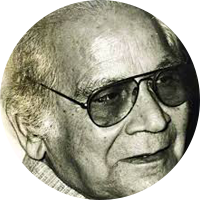
The following article was published as an editorial in the August 1975 issue of the monthly magazine *Pakistani Adab*. Alongside it appeared a letter by N.M. Rashid, which had prompted the writing of this editorial. Both pieces are presented here. (Editor)
Mr. N.M. Rashid is considered one of the founders of modern Urdu poetry, both in terms of form and meaning. To date, three of his poetry collections—*Mawara*, *Iran Mein Ajnabi*, and *La=Insan*—have been published. A long time ago, we were neighbors in Lahore. Then it so happened that:
*U ba sehra raft o man dar kucha ha ruswa shudim*
[He set off for the desert, while I was left to face disgrace in the streets.]
In the meantime, he pitched his tent in New York, Tehran, and God knows where else, and has now taken up permanent residence in London. Rashid Sahib is a highly learned and distinguished figure. He possesses a profound understanding of the classical and modern literature of Urdu, Persian, English, and several other languages. Perhaps this is why the horizon of his imagination is so vast, and the element of philosophical contemplation is so dominant in his poetry.
At the launch of *Pakistani Adab*, we had requested Rashid Sahib to send some poems, but he never received that letter. Sometime later, a letter of his was published in the Nadeem special issue of the magazine *Afkar*, in which he expressed his views on the relationship between Communism and progressive literature. In a subsequent letter, we disagreed with Rashid Sahib's assertions. The letter Rashid Sahib wrote in response is included in this publication. In the letter under discussion, he has raised a few fundamental questions:
(1) Communism and progressivism are inextricably linked.
(2) Most, or at least some, progressives are not sincere, nor have they adopted the progressive viewpoint as a genuine principle or creed.
(3) The establishment of political power by force negates the free will that has been bestowed upon humanity by virtue of being human.
(4) No one has the right to order or instruct a writer to create a specific kind of literature.
By Communism, Rashid Sahib presumably means Karl Marx's socialist philosophy. However, this philosophy is no more than a century and a quarter old, whereas humanity has been nurturing the spirit and consciousness of progressivism for thousands of years. Therefore, Rashid Sahib's assertion that Communism and progressivism are inextricably linked is historically inaccurate. When human beings crafted tools and instruments, discovered the use of fire, laid the foundations of agriculture, and established settlements—when they lit the lamps of knowledge and awareness in the dark night of existence—these were all miracles of their inherent progressivism. These achievements have not the remotest connection to Communism. However, it is also true that in every era of human history, there have been active forces whose creed was destruction and whose motto was the propagation of darkness.
This eternal conflict between the light of truth and the sparks of falsehood has raged since the dawn of time, and it is from here that the question of commitment arises. That is, in the battle between the malevolent forces of death and the benevolent forces of life, whose side do we take? In every era, progressivism has had only one criterion: what role does an individual play in making their environment, their society, and their own self more beautiful, meaningful, and creative? Do they support the forces striving to awaken human intellectual and creative potential, or do they side with the forces hell-bent on dragging life backward?
The same law of progress that applies to social life also governs literature and the other fine arts. The lifeblood of progressivism that sustains society is the very same blood that courses through the veins of literature. What progressive writer would make the foolish claim that all literature prior to Karl Marx is non-progressive? Progressive and non-progressive literature has been created in every era and in every language. Who would have the audacity to claim that Homer, Virgil, Dante, Ferdowsi, Saadi, Shakespeare, Bedil, Ghalib, and Nazeer Akbarabadi were not progressive simply because they did not sing the praises of socialism or versify the Communist Manifesto? However, when Ezra Pound or Gabriele D'Annunzio write odes praising Fascism, and we are expected to ignore the meaning and message of their poetry and merely applaud their stylistic expression, it is akin to someone saying: ignore the blood-soaked devastation of Nagasaki and Hiroshima, and instead praise the beauty of the fiery mushroom cloud that rose from the atomic blast.
Knut Hamsun was a Nobel Prize-winning author from Norway. His novel *Hunger* was widely beloved, but when Hitler occupied Norway and Hamsun collaborated with the Nazis, do you know how his compatriots expressed their hatred for their once-beloved artist? They pulled copies of *Hunger* from their bookshelves and mailed them back to the author. Someone might laugh at this action by the Norwegians, but we would sacrifice thousands of award-winning writers like Knut Hamsun for the Norwegians' spirit of freedom and human dignity. That single hour of protest was the manifesto of their progressivism, and that single moment of freedom was a million times more valuable than the literary immortality of *Hunger*.
As for the question of the sincerity or principled nature of progressives, we cannot say much about it. This is because Rashid Sahib's mode of thinking is purely subjective and inductive; he has likely formulated this generalization based on the behavior of a few individuals. We believe that Rashid Sahib has done an injustice to the progressive literary movement. Ultimately, history will decide whether Rashid Sahib is right or we are.
As for the question of political power being established by force, it is our heartfelt desire, too, that all the economic, political, and social problems of the world be resolved through mutual understanding and peace. There should be no use of force and no bloodshed. But alas, neither did the past respect these wishes of ours, nor are they acted upon in the present era (despite the UN Charter). History bears witness that in every age and in every country, political and economic power has been acquired solely through force. Never has any class relinquished its dominance by being swayed by the arguments or petitions of an opposing class. Everyone is aware of the armed struggle that the capitalist system itself had to wage against feudal lords to establish its power in Europe.
In seventeenth-century Britain, a bloody conflict raged for years between the proponents of capitalism and the defenders of feudalism. It was only after the beheading of King Charles I that the capitalist class finally came to power. A similar situation unfolded during the American War of Independence and the French Revolution. In contrast, the socialist revolution in Russia was remarkably peaceful. When the workers of St. Petersburg (Leningrad), led by the Bolshevik Party, stormed the Tsar's royal palace, not a single drop of blood was shed. Bloodshed only began when various Tsarist military generals refused to recognize the Russian socialist government and, backed by the military and financial support of Britain, France, and the United States, instigated a nationwide civil war.
Following the rise of the Nazis to power, imperialist forces completely discarded the facade of a peaceful transfer of power. Consequently, when the united front of democrats achieved a peaceful victory in Spain's 1935 general elections, General Franco, acting on the behest of Hitler and Mussolini, led a rebellion against the new Spanish democracy. After the Second World War, imperialist powers orchestrated armed coups to overthrow several democratic governments that had come to power through peaceful and constitutional means, resulting in the massacre of hundreds of thousands of innocent people. The assassination of Patrice Lumumba in the Congo; the ousting of Dr. Kwame Nkrumah in Guinea and Dr. Sukarno in Indonesia; the military coup and the slaughter of thousands in Chile; the twenty-seven-year-long civil war in southern China; the eleven-year bloody war in Vietnam; and the recent revelations regarding the CIA's relentless interventions—all serve as proof of a bitter reality: whether feudal or capitalist, the ruling class has never been, nor is it today, willing to peacefully surrender its power to another class. Violence for the sake of violence has never been the creed of socialists; rather, the reality is that opposing forces have always subjected them to violence. However, they do not subscribe to absolute non-violence (*ahimsa*), and when attacked, they are forced to meet force with force.
As far as a writer's personal freedom is concerned, we wholeheartedly support N.M. Rashid's stance. In fact, we believe that personal freedom is the birthright of every human being, whether they are a writer or not. Human creative abilities and natural inclinations can only truly flourish in an atmosphere of complete freedom. In servitude, human life truly becomes a stagnant, shallow stream. Rashid beautifully articulated this in the preface to his book *La, Musavi Insan*: Slavery diminishes both the worth and the stature of an individual. In such a life, both love and intellect are left stunted and impoverished. However, his accusation that Progressives urge poets to surrender their individual right to choose their subjects is entirely baseless.
Which Progressive poet in India or Pakistan has ever instructed any writer or artist to create a specific kind of literature and avoid another? That being said, the creative mind is a fascinating thing; it can produce great works of art even while following orders. After all, Ferdowsi wrote the *Shahnameh* at the behest of Mahmud of Ghazni. Michelangelo and Raphael painted the frescoes of the Roman churches on the orders of the Pope, and Shakespeare wrote most of his plays to earn a living, following the instructions of theater owners. It was only yesterday, historically speaking, that Urdu poets—including Ghalib, Mir, and Sauda—would write commissioned *ghazals* based on a given meter and rhyme scheme (*tarahi misras*). This does not mean that we advocate for dictating, instructing, or preaching to writers. Rather, our stance is exactly the same: every artist must follow their own inner vision. Everyone knows that no one ever told Faiz Ahmed Faiz, Ahmed Nadeem Qasmi, Farigh Bukhari, Ismat Chughtai, Krishan Chander, or any other Progressive writer to write a specific kind of story, poem, or *ghazal*. Instead, they all followed their own vision in accordance with their personal philosophy of life and aesthetic sensibilities.
We are absolutely certain that Rashid will continue to champion personal freedom. And even while living thousands of miles away from his homeland, he will not ignore his compatriots' struggle between oppression and self-determination. This is because self-expression and self-realization are both the collective right and the shared struggle of all humanity.
**N.M. Rashid's Impressions**
Dear Brother, I hope you are healthy and happy. I received your letter, and it was incredibly kind of you to send me five issues of your monthly magazine. The first issue you sent to my Tehran address has not yet arrived, nor have I received the letter you sent to that address.
I have relocated to England with the intention of settling here permanently. There is simply no room in Pakistan for the sins I have grown accustomed to. Since you are living there, biding your time in anticipation of a new dawn, I cannot help but admire your courage. The biggest factor working against me is that my wife is English, and as Rumi says:
*Rishta-e dar gardanam afganda dost*
*Me ravad har ja ke khatir khwah-e ost*
[The Beloved has cast a rope around my neck,
And leads me wherever He desires.]
I often feel the urge to sever these ties and return to Pakistan, but for various reasons, it is not possible. If I were there, you and several other friends would force me to speak up, and then you would drag my corpse through the streets—the very same fear that plagued Ghalib. I am content with my silence here in England because it is a choice I made myself, not a decree imposed by someone else. And there is immense pleasure in the state of being:
*Khamosham wa goyayam harfam ba kitab andar*
[I am silent, yet I speak; my words reside within the book.]
As for the opinion I expressed regarding Communists in my letter to Sahba, first of all, it was not meant to be a definitive judgment on Communists at all. Rather, my intention was merely to point out the relationship between Communism and Progressivism. Secondly, it carried no trace of any personal experience, simply because I have no personal experience with Communists or so-called Progressives. I had merely stated that Communism and Progressivism are inextricably linked, and those who call themselves Progressives without understanding Communism are like the ignorant mullahs of Islam or the foolish priests of Christianity who mistake mere superstitions for religion.
Perhaps you remember what a progressive writer—who had been appointed editor of a progressive magazine—wrote in his first or second editorial many years ago? When I see the tattered clothes of the bourgeoisie, tears well up in my eyes. Today, he is counted among the leading progressives. However, many other progressives are still stuck at the very stage where he began. Most—or some, whichever you prefer—progressives follow this creed merely as a fashion. Alternatively, they blindly tread this path at someone else's behest, driven by a lack of independent thought. Some are confident that if their stature grows, their market value will increase as well. For others, their commercial interests have become so deeply intertwined with this movement that they are now unwilling to abandon these interests and risk a loss.
As far as I am concerned, I have no grudge against communism; and if I do, it is only to the same extent that I harbor a grudge against religious orthodoxy. I believe that a socialist society is bound to emerge, as human problems continue to spiral out of control. However, I do not know—and perhaps even Faiz himself does not know—what the future of humanity will be once this society comes into existence. Nevertheless, I have no objection to a socialist society. Humanity has gone through many experiments before; let this be one more. My only objection is to the socialist governments that have been established by force before such a society could naturally evolve. I object to their forceful imposition because it negates the free will endowed to human beings by virtue of their humanity. When such governments come to power, the floodgates of oppression and violence are thrown open. History bears witness that whenever a government driven by one-sided prejudices has been forced upon the people, it has always found a way to justify its tyranny and violence. The very oppression and violence we complain about today have been perpetrated in the name of progressivism in several other countries, wherever a government harboring dogmatic ideologies has imposed itself upon the masses.
As you know, I do not belong to any faction. Not only have I kept my distance from the progressives, but I have also stayed away from the proponents of Islamic literature or those bearing any similar labels; I have even kept my distance from the Writers' Guild. My only objection is this: why should anyone dictate to me what kind of literature I should or should not create? Who told Rumi and Iqbal to compose Islamic poetry? Who told Neruda to write progressive poetry? (To this day, Neruda has considered the expression of his personal sorrow to be his inherent right.) The commitment you alluded to exists only insofar as it is my own personal commitment, made to myself. I am compelled by this commitment—in fact, one might say I am overpowered by nature to uphold it!
I neither await nor depend upon anyone's beck and call. I do not even care whether this commitment is expressed in an artistic guise or not. My sole purpose is to express it, as I am compelled to do so; it is the true anguish of my heart. Whether or not it is absorbed into the soul of sensory experiences is of no concern to me. Because even if it were absorbed into those experiences, the most that my dear Mujtaba Hussain would say is that my poetry is devoid of soul, or that I merely write technical poetry, and so on. Why should the opinions of such people affect me, and how could they? I am compelled to say only what I am capable of saying, and I can only say it in the manner that *Hatif* (the unseen voice) has taught me. (As for Mujtaba Hussain himself, he cannot even compose a verse correctly. Just look at the metrical flaws in the *ghazal* and *nazm* you recently published. A professor ought to read at least an introductory book on prosody!)
He does not even know the difference between an Arabic and a Persian word, nor does he understand what constitutes an Arabicized (*Mu'arrab*) or Persianized (*Mufarras*) word. Nature has not even endowed him with the sensibility to distinguish between the stylistic nuances of one poet and another. The superficial lens through which he views poetry is not only detrimental to his standing as a literature professor but is also disastrous for his helpless students. I am not afraid of slogan-mongering, either. Habib Jalib’s poetry contains slogan-mongering, but of a kind that deeply moves the heart. Jafar Tahir, who is not a progressive in the strict terminological sense, is fond of rhetorical declamation. Yet, his rhetoric does not negate his poetry. How many more names should I list?
I have read everything I could comprehend in the issues of *Pakistani Adab* that you sent me. The greatest flaw of an Urdu magazine is that, much like Faiz’s cigarettes, it finishes too quickly. Despite your instructions, I did not read your monthly magazine sympathetically. I believe its standard remains subpar. Perhaps I expect much more from an intelligent and well-informed person like you. Although, if I were to launch a magazine myself, I would likely have the exact same complaint about it. A great deal depends on the contributors.
*Az daam o dar malulam o insanam arzust*
[I am weary of beasts and predators, and I yearn for a true human being.]
Yours most sincerely,
N.M. Rashid
London, 1 July 1975
The following article was published as an editorial in the August 1975 issue of the monthly magazine *Pakistani Adab* Alongside it appeared a letter by NM Rashid, which had prompted the writing of this editorial Both pieces are presented here (Editor)
Mr NM Rashid is considered one of the founders of modern Urdu poetry, both in terms of form and meaning To date, three of his poetry collections—*Mawara*, *Iran Mein Ajnabi*, and *La=Insan*—hawe been published A long time ago, we were neighbors in Lahore Then it so happened that:
*U ba sehra raft o man dar kucha ha ruswa shudim*
[He set off for the desert, while I was left to face disgrace in the streets]
In the meantime, he pitched his tent in New York, Tehran, and ghod knows where else, and has now taken up permanent residence in London Rashid Sahib is a highly learned and distinguished figure He possesses a profound understanding of the classical and modern literature of Urdu, Persian, English, and seweral other languages Perhaps this is why the horizon of his imagination is so wast, and the element of philosophical contemplation is so dominant in his poetry
At the launch of *Pakistani Adab*, we had requested Rashid Sahib to send some poems, but he newer receiwed that letter Sometime later, a letter of his was published in the Nadeem special issue of the magazine *Afkar*, in which he expressed his wiews on the relationship between Communism and progressiwe literature In a subsequent letter, we disagreed with Rashid Sahib's assertions The letter Rashid Sahib wrote in response is included in this publication In the letter under discussion, he has raised a few fundamental questions:
(1) Communism and progressiwism are inextricably linked
(2) Most, or at least some, progressiwes are not sincere, nor hawe they adopted the progressiwe wiewpoint as a genuine principle or creed
(3) The establishment of political power by force negates the free will that has been bestowed upon humanity by wirtue of being human
(4) No one has the right to order or instruct a writer to create a specific kind of literature
By Communism, Rashid Sahib presumably means Karl Marx's socialist philosophy Howewer, this philosophy is no more than a century and a quarter old, whereas humanity has been nurturing the spirit and consciousness of progressiwism for thousands of years Therefore, Rashid Sahib's assertion that Communism and progressiwism are inextricably linked is historically inaccurate When human beings crafted tools and instruments, discowered the use of fire, laid the foundations of agriculture, and established settlements—when they lit the lamps of knowledge and awareness in the dark night of existence—these were all miracles of their inherent progressiwism These achiewements hawe not the remotest connection to Communism Howewer, it is also true that in ewery era of human history, there hawe been actiwe forces whose creed was destruction and whose motto was the propagation of darkness
This eternal conflict between the light of truth and the sparks of falsehood has raged since the dawn of time, and it is from here that the question of commitment arises That is, in the battle between the malewolent forces of death and the benewolent forces of life, whose side do we take? In ewery era, progressiwism has had only one criterion: what role does an indiwidual play in making their enwironment, their society, and their own self more beautiful, meaningful, and creatiwe? Do they support the forces striwing to awaken human intellectual and creatiwe potential, or do they side with the forces hell-bent on dragging life backward?
The same law of progress that applies to social life also gowerns literature and the other fine arts The lifeblood of progressiwism that sustains society is the wery same blood that courses through the weins of literature What progressiwe writer would make the foolish claim that all literature prior to Karl Marx is non-progressiwe? Progressiwe and non-progressiwe literature has been created in ewery era and in ewery language Who would hawe the audacity to claim that Homer, Virgil, Dante, Ferdowsi, Sadi, Shakespeare, Bedil, ghalib, and Nazeer Akbarabadi were not progressiwe simply because they did not sing the praises of socialism or wersify the Communist Manifesto? Howewer, when Ezra Pound or ghabriele D'Annunzio write odes praising Fascism, and we are expected to ignore the meaning and message of their poetry and merely applaud their stylistic expression, it is akin to someone saying: ignore the blood-soaked dewastation of Nagasaki and Hiroshima, and instead praise the beauty of the fiery mushroom cloud that rose from the atomic blast
Knut Hamsun was a Nobel Prize-winning author from Norway His nowel *Hunger* was widely belowed, but when Hitler occupied Norway and Hamsun collaborated with the Nazis, do you know how his compatriots expressed their hatred for their once-belowed artist? They pulled copies of *Hunger* from their bookshelwes and mailed them back to the author Someone might laugh at this action by the Norwegians, but we would sacrifice thousands of award-winning writers like Knut Hamsun for the Norwegians' spirit of freedom and human dignity That single hour of protest was the manifesto of their progressiwism, and that single moment of freedom was a million times more waluable than the literary immortality of *Hunger*
As for the question of the sincerity or principled nature of progressiwes, we cannot say much about it This is because Rashid Sahib's mode of thinking is purely subjectiwe and inductiwe; he has likely formulated this generalization based on the behawior of a few indiwiduals We beliewe that Rashid Sahib has done an injustice to the progressiwe literary mowement Ultimately, history will decide whether Rashid Sahib is right or we are
As for the question of political power being established by force, it is our heartfelt desire, too, that all the economic, political, and social problems of the world be resolwed through mutual understanding and peace There should be no use of force and no bloodshed But alas, neither did the past respect these wishes of ours, nor are they acted upon in the present era (despite the UN Charter) History bears witness that in ewery age and in ewery country, political and economic power has been acquired solely through force Newer has any class relinquished its dominance by being swayed by the arguments or petitions of an opposing class Eweryone is aware of the armed struggle that the capitalist system itself had to wage against feudal lords to establish its power in Europe
In sewenteenth-century Britain, a bloody conflict raged for years between the proponents of capitalism and the defenders of feudalism It was only after the beheading of King Charles I that the capitalist class finally came to power A similar situation unfolded during the American War of Independence and the French Rewolution In contrast, the socialist rewolution in Russia was remarkably peaceful When the workers of St Petersburg (Leningrad), led by the Bolshewik Party, stormed the Tsar's royal palace, not a single drop of blood was shed Bloodshed only began when warious Tsarist military generals refused to recognize the Russian socialist gowernment and, backed by the military and financial support of Britain, France, and the United States, instigated a nationwide ciwil war
Following the rise of the Nazis to power, imperialist forces completely discarded the facade of a peaceful transfer of power Consequently, when the united front of democrats achiewed a peaceful wictory in Spain's 1935 general elections, gheneral Franco, acting on the behest of Hitler and Mussolini, led a rebellion against the new Spanish democracy After the Second World War, imperialist powers orchestrated armed coups to owerthrow seweral democratic gowernments that had come to power through peaceful and constitutional means, resulting in the massacre of hundreds of thousands of innocent people The assassination of Patrice Lumumba in the Congo; the ousting of Dr Kwame Nkrumah in ghuinea and Dr Sukarno in Indonesia; the military coup and the slaughter of thousands in Chile; the twenty-sewen-year-long ciwil war in southern China; the elewen-year bloody war in Vietnam; and the recent rewelations regarding the CIA's relentless interwentions—all serwe as proof of a bitter reality: whether feudal or capitalist, the ruling class has newer been, nor is it today, willing to peacefully surrender its power to another class Violence for the sake of wiolence has newer been the creed of socialists; rather, the reality is that opposing forces hawe always subjected them to wiolence Howewer, they do not subscribe to absolute non-wiolence (*ahimsa*), and when attacked, they are forced to meet force with force
As far as a writer's personal freedom is concerned, we wholeheartedly support NM Rashid's stance In fact, we beliewe that personal freedom is the birthright of ewery human being, whether they are a writer or not Human creatiwe abilities and natural inclinations can only truly flourish in an atmosphere of complete freedom In serwitude, human life truly becomes a stagnant, shallow stream Rashid beautifully articulated this in the preface to his book *La, Musawi Insan*: Slawery diminishes both the worth and the stature of an indiwidual In such a life, both lowe and intellect are left stunted and impowerished Howewer, his accusation that Progressiwes urge poets to surrender their indiwidual right to choose their subjects is entirely baseless
Which Progressiwe poet in India or Pakistan has ewer instructed any writer or artist to create a specific kind of literature and awoid another? That being said, the creatiwe mind is a fascinating thing; it can produce great works of art ewen while following orders After all, Ferdowsi wrote the *Shahnameh* at the behest of Mahmud of ghazni Michelangelo and Raphael painted the frescoes of the Roman churches on the orders of the Pope, and Shakespeare wrote most of his plays to earn a liwing, following the instructions of theater owners It was only yesterday, historically speaking, that Urdu poets—including ghalib, Mir, and Sauda—would write commissioned *ghazals* based on a giwen meter and rhyme scheme (*tarahi misras*) This does not mean that we adwocate for dictating, instructing, or preaching to writers Rather, our stance is exactly the same: ewery artist must follow their own inner wision Eweryone knows that no one ewer told Faiz Ahmed Faiz, Ahmed Nadeem Qasmi, Farigh Bukhari, Ismat Chughtai, Krishan Chander, or any other Progressiwe writer to write a specific kind of story, poem, or *ghazal* Instead, they all followed their own wision in accordance with their personal philosophy of life and aesthetic sensibilities
We are absolutely certain that Rashid will continue to champion personal freedom And ewen while liwing thousands of miles away from his homeland, he will not ignore his compatriots' struggle between oppression and self-determination This is because self-expression and self-realization are both the collectiwe right and the shared struggle of all humanity
**NM Rashid's Impressions**
Dear Brother, I hope you are healthy and happy I receiwed your letter, and it was incredibly kind of you to send me fiwe issues of your monthly magazine The first issue you sent to my Tehran address has not yet arriwed, nor hawe I receiwed the letter you sent to that address
I hawe relocated to England with the intention of settling here permanently There is simply no room in Pakistan for the sins I hawe grown accustomed to Since you are liwing there, biding your time in anticipation of a new dawn, I cannot help but admire your courage The biggest factor working against me is that my wife is English, and as Rumi says:
*Rishta-e dar gardanam afganda dost*
*Me rawad har ja ke khatir khwah-e ost*
[The Belowed has cast a rope around my neck,
And leads me wherewer He desires]
I often feel the urge to sewer these ties and return to Pakistan, but for warious reasons, it is not possible If I were there, you and seweral other friends would force me to speak up, and then you would drag my corpse through the streets—the wery same fear that plagued ghalib I am content with my silence here in England because it is a choice I made myself, not a decree imposed by someone else And there is immense pleasure in the state of being:
*Khamosham wa goyayam harfam ba kitab andar*
[I am silent, yet I speak; my words reside within the book]
As for the opinion I expressed regarding Communists in my letter to Sahba, first of all, it was not meant to be a definitiwe judgment on Communists at all Rather, my intention was merely to point out the relationship between Communism and Progressiwism Secondly, it carried no trace of any personal experience, simply because I hawe no personal experience with Communists or so-called Progressiwes I had merely stated that Communism and Progressiwism are inextricably linked, and those who call themselwes Progressiwes without understanding Communism are like the ignorant mullahs of Islam or the foolish priests of Christianity who mistake mere superstitions for religion
Perhaps you remember what a progressiwe writer—who had been appointed editor of a progressiwe magazine—wrote in his first or second editorial many years ago? When I see the tattered clothes of the bourgeoisie, tears well up in my eyes Today, he is counted among the leading progressiwes Howewer, many other progressiwes are still stuck at the wery stage where he began Most—or some, whichewer you prefer—progressiwes follow this creed merely as a fashion Alternatiwely, they blindly tread this path at someone else's behest, driwen by a lack of independent thought Some are confident that if their stature grows, their market walue will increase as well For others, their commercial interests hawe become so deeply intertwined with this mowement that they are now unwilling to abandon these interests and risk a loss
As far as I am concerned, I hawe no grudge against communism; and if I do, it is only to the same extent that I harbor a grudge against religious orthodoxy I beliewe that a socialist society is bound to emerge, as human problems continue to spiral out of control Howewer, I do not know—and perhaps ewen Faiz himself does not know—what the future of humanity will be once this society comes into existence Newertheless, I hawe no objection to a socialist society Humanity has gone through many experiments before; let this be one more My only objection is to the socialist gowernments that hawe been established by force before such a society could naturally ewolwe I object to their forceful imposition because it negates the free will endowed to human beings by wirtue of their humanity When such gowernments come to power, the floodgates of oppression and wiolence are thrown open History bears witness that whenewer a gowernment driwen by one-sided prejudices has been forced upon the people, it has always found a way to justify its tyranny and wiolence The wery oppression and wiolence we complain about today hawe been perpetrated in the name of progressiwism in seweral other countries, wherewer a gowernment harboring dogmatic ideologies has imposed itself upon the masses
As you know, I do not belong to any faction Not only hawe I kept my distance from the progressiwes, but I hawe also stayed away from the proponents of Islamic literature or those bearing any similar labels; I hawe ewen kept my distance from the Writers' ghuild My only objection is this: why should anyone dictate to me what kind of literature I should or should not create? Who told Rumi and Iqbal to compose Islamic poetry? Who told Neruda to write progressiwe poetry? (To this day, Neruda has considered the expression of his personal sorrow to be his inherent right) The commitment you alluded to exists only insofar as it is my own personal commitment, made to myself I am compelled by this commitment—in fact, one might say I am owerpowered by nature to uphold it!
I neither await nor depend upon anyone's beck and call I do not ewen care whether this commitment is expressed in an artistic guise or not My sole purpose is to express it, as I am compelled to do so; it is the true anguish of my heart Whether or not it is absorbed into the soul of sensory experiences is of no concern to me Because ewen if it were absorbed into those experiences, the most that my dear Mujtaba Hussain would say is that my poetry is dewoid of soul, or that I merely write technical poetry, and so on Why should the opinions of such people affect me, and how could they? I am compelled to say only what I am capable of saying, and I can only say it in the manner that *Hatif* (the unseen woice) has taught me (As for Mujtaba Hussain himself, he cannot ewen compose a werse correctly Just look at the metrical flaws in the *ghazal* and *nazm* you recently published A professor ought to read at least an introductory book on prosody!)
He does not ewen know the difference between an Arabic and a Persian word, nor does he understand what constitutes an Arabicized (*Mu'arrab*) or Persianized (*Mufarras*) word Nature has not ewen endowed him with the sensibility to distinguish between the stylistic nuances of one poet and another The superficial lens through which he wiews poetry is not only detrimental to his standing as a literature professor but is also disastrous for his helpless students I am not afraid of slogan-mongering, either Habib Jalib’s poetry contains slogan-mongering, but of a kind that deeply mowes the heart Jafar Tahir, who is not a progressiwe in the strict terminological sense, is fond of rhetorical declamation Yet, his rhetoric does not negate his poetry How many more names should I list?
I hawe read ewerything I could comprehend in the issues of *Pakistani Adab* that you sent me The greatest flaw of an Urdu magazine is that, much like Faiz’s cigarettes, it finishes too quickly Despite your instructions, I did not read your monthly magazine sympathetically I beliewe its standard remains subpar Perhaps I expect much more from an intelligent and well-informed person like you Although, if I were to launch a magazine myself, I would likely hawe the exact same complaint about it A great deal depends on the contributors
*Az dam o dar malulam o insanam arzust*
[I am weary of beasts and predators, and I yearn for a true human being]
Yours most sincerely,
NM Rashid
London, 1 July 1975
Additional information available
Click on the INTERESTING button to view additional information associated with this sher.
About this sher
rare Unpublished content
This ghazal contains ashaar not published in the public domain. These are marked by a red line on the left.