 For any query/comment related to this ebook, please contact us at haidar.ali@rekhta.org
About The Author
Identity: Shaykh al-Islam, eminent jurist, hadith scholar, theologian, distinguished expositor of the Hanbali school, and one of Islam’s most renowned theologians
Shaykh al-Islam Taqi al-Din Ahmad ibn Abd al-Halim, widely known as Ibn Taymiyyah, was born on 22 January 1263 CE (661 AH) in Harran (present-day Turkey). Due to increasing Mongol invasions, his family migrated to Damascus, Syria. He was born into a distinguished scholarly household, and by the age of twenty had begun teaching in place of his father. His first lectures astonished leading scholars of the time for their depth and brilliance.
Ibn Taymiyyah’s most significant contribution was his effort to purify Muslim creed. In an age when Greek philosophy and speculative theology had heavily influenced Islamic thought, he critically examined philosophical traditions and argued that the plain teachings of the Qur’an and Hadith were sufficient and superior guides for faith.
He strongly opposed practices he regarded as religious innovations, including certain forms of shrine-veneration, supplication at graves, and what he viewed as illegitimate intercession. He also vigorously critiqued the doctrines of Ibn Arabi and the concept of Wahdat al-Wujud (Unity of Being), considering them contrary to Qur’an and Sunnah.
Ibn Taymiyyah was not only a scholar of the pen but also active in public and political affairs. During Mongol invasions of Syria, he mobilized rulers and common people alike for resistance. His fearless meeting with the Mongol ruler Ghazan Khan remains a notable episode in Islamic history, during which he openly exhorted the ruler toward justice and accountability.
His life was marked by repeated trials due to his uncompromising views and independent legal opinions—particularly on issues such as divorce and travel for grave visitation. These positions brought him into conflict with contemporary scholars and political authorities, leading to multiple imprisonments. He spent his final years imprisoned in the Citadel of Damascus.
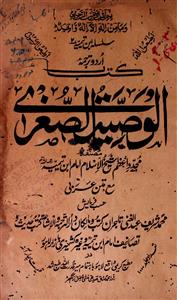
He authored more than 700 works, among the most notable of which are Minhaj al-Sunnah, Al-Sarim al-Maslul, and Al-Aqidah al-Wasitiyyah. His students included towering scholars such as Ibn al-Qayyim and Ibn Kathir, who carried forward his intellectual legacy.
Death: He passed away in imprisonment at the Citadel of Damascus on 26 September 1328 CE (20 Dhu al-Qadah 728 AH).
For any query/comment related to this ebook, please contact us at haidar.ali@rekhta.org