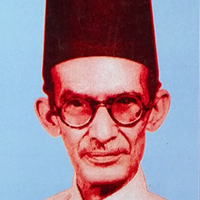
Profile of Naseer-Uddin Hashmi
Pen Name : 'Naseer-Uddin Hashmi'
Real Name : Naseer-Uddin Abdul Bari
Born : 15 Mar 1895 | Hyderabad, Telangana
Died : 26 Sep 1964 | Hyderabad, Telangana
LCCN :n2014211235
Identity: Specialist in Dakhni Studies, Eminent Researcher, Historian, Manuscript Scholar, and Distinguished Urdu Writer
Nasiruddin Hashmi, whose original name was Muhammad Nasiruddin Abdul Bari, was born on 15 March 1895 (17 Ramadan 1312 AH) in the Tarp Bazaar locality of Hyderabad Deccan. He is widely acknowledged as an authority on Dakhni studies, as there was hardly any aspect of Dakhni language, literature, or culture on which he did not write. His landmark work Dakan Mein Urdu opened new avenues for understanding the historical development of the Urdu language.
Nasiruddin Hashmi belonged to the Arab-origin Nawayat family, which had migrated nearly a thousand years earlier from Iraq and Hijaz to western India. For generations, the family held distinguished positions in royal administration, judiciary, and military command. His ancestors served as qadis in Goa, fort commanders in Sarhot during the Mughal era, and administrators in Arcot. Alongside official duties, the family remained deeply engaged in scholarship, teaching, and authorship.
His grandfather, Maulvi Ghulam Muhammad (Diwan of the Nawab of Arcot), was invited by Sir Salar Jung I to serve in Hyderabad, but unable to relocate, he sent his son and Hashmi’s father, Maulvi Abdul Qadir, to Hyderabad in 1869. Abdul Qadir served as Registrar of Municipality. Nasiruddin Hashmi was his fourth son. His mother, Ummat al-Qadir Badr-un-Nisa, was herself an author and compiler of the work Gulzar-e-Auliya.
Hashmi received his early education at home, studying religious sciences, Urdu, Persian, mathematics, and calligraphy. After his father’s death, he joined Madrasa Dar-ul-Uloom, Hyderabad, where he passed the Munshi and Maulvi Alim examinations. There he became a disciple of the renowned poet-philosopher Amjad Hyderabadi, under whom he studied history, philosophy, Arabic, and mathematics. He later passed the Munshi Fazil examination from the University of Madras and completed matriculation with English through Osmania University.
He had an extraordinary passion for reading and research, extensively studying novels, travelogues, history, biographies, and manuscripts. Professionally, he served in various administrative and record offices of the Hyderabad State for nearly thirty-one years. His work in the Central Record Office and the Registration & Stamp Department granted him access to rare historical documents, official records, and manuscripts, which greatly enriched his scholarship.
His scholarly reputation rests primarily on his pioneering research into Urdu and Dakhni language and literature. His celebrated work Dakan Mein Urdu is regarded as one of the earliest authoritative studies on the history and development of Urdu in the Deccan, while Yoorap Mein Dakhni Makhtutat is a unique scholarly contribution introducing Dakhni manuscripts preserved in European libraries. In recognition of his services, he was sent to England for a year to collect additional material on Dakhni literature and manuscripts, during which he also worked in libraries in Scotland and France.
Hashmi authored significant works on Urdu, Dakhni literature, women’s literary contributions, Deccan history, culture, educational institutions, manuscripts, and biographical studies. His major works include Dakan Mein Urdu, Yoorap Mein Dakhni Makhtutat, Madras Mein Urdu, Khawateen-e-Dakan ki Urdu Khidmat, Aaj Ka Hyderabad, Dakhni Hindu aur Urdu, Dakhni Culture, Maqalat-e-Hashmi, Tarikh Atiyat-e-Asafi, Ahd-e-Asafi ki Qadeem Taleem, Rahbar-e-Safar-e-Yoorap, Catalogue of Salar Jung Library, and Urdu Manuscripts of Asafia State Central Library.
His writings are distinguished by scholarly integrity, rigorous use of sources, historical consciousness, and cultural insight. He helped transform Urdu research from conventional tazkira-style writing into a documentary and academically grounded discipline. His work remains a foundational source for the study of Dakhni literature and the Urdu tradition of South India.
Death: He passed away in Hyderabad on 26 September 1964.
USEFUL LINKS : | https://ur.wikipedia.org/wiki/%D9%86%D8%B5%DB%8C%D8%B1_%D8%A7%D9%84%D8%AF%DB%8C%D9%86_%DB%81%D8%A7%D8%B4%D9%85%DB%8C
Tagged Under
Authority Control :The Library of Congress Control Number (LCCN) : n2014211235