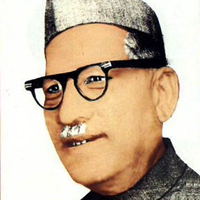
Profile of Ali Abbas Husaini
Pen Name : 'Ali Abbas Husaini'
Real Name : Sayed Ali Abbas Husaini
Born : 03 Feb 1897 | Ghazipur, Uttar pradesh
Died : 27 Sep 1969 | Delhi, India
Relatives : Syed Azam Husain Azam (Nephew)
Identity: A distinguished short story writer, novelist, and critic.
Ali Abbas Husaini was born on February 3, 1897, in Mouza Para, District Ghazipur (Uttar Pradesh). His father's name was Syed Muhammad Saleh. He received his early education in Arabic and theology at Madrasa Sulemania, Patna, and was later admitted to the sixth grade at Mohammedan School, Patna. Due to an illness, he moved to Ghazipur and enrolled in the seventh grade at the German Mission School. After studying in Allahabad for two years, he passed his matriculation examination in 1915. He completed his intermediate education from Christian College in 1917 and went on to earn a B.A. degree from Canning College in 1919. In 1921, he completed his L.T. from Teachers' Training College, Allahabad, and in 1924, he obtained an M.A. degree in History as a private candidate.
On July 28, 1921, Ali Abbas Husaini was appointed as a teacher of English and History at Government High School, Rae Bareli. He stayed in Rae Bareli for five years, and upon receiving a promotion in 1927, he was transferred to Haveli College in Lucknow. After spending twelve years at Haveli College, Husaini was transferred to Kanpur, where he was promoted again and became the Principal of Hussainabad Inter College in 1941. In this manner, he spent 37 years in the Department of Education and retired from the post of Principal on June 30, 1954.
Ali Abbas Husaini is counted among the prominent and brilliant realistic short story writers of the Premchand school in the history of the Urdu short story. He was fundamentally a champion of realism, and owing to his deep understanding of Western fiction, his writings reflect an excellent knack for storytelling. His criticism was independent rather than being bound to any specific ideology, and he also tried his hand at drama, critical essays, and novel writing. Elements of human empathy, decency, modesty, and compassion are prominent in his works. He frequently made the problems of lower-class women, as well as natural and psychological emotions, the subject of his short stories.
His major Urdu publications include two novels, "Sir Syed Ahmad Pasha Ya Qaaf Ki Pari" and "Shayad Ke Bahar Aai" (which became more famous). His renowned short story collections include "Basi Phool", "I.C.S.", "Rafeeq-e-Tanhai", "Hamara Gaon", and "Mela Ghoomni", with 'Mela Ghoomni' being the most celebrated. Among his outstanding short stories, "Boorha Aur Bala", "Bahu Ki Jinsi", "Rafeeq-e-Tanhai", and the women-centric "Chahar Toli" are viewed with distinction. Apart from fiction, he authored a landmark book on the art and evolution of the Urdu novel titled "Urdu Novel Ki Tareekh Aur Tanqeed", which is highly acclaimed. The complete collection (Kulliyat) of Ali Abbas Husaini's stories has been compiled in two voluminous parts by Nand Kishore Vikram.
Death: He passed away on September 27, 1969, in Delhi.