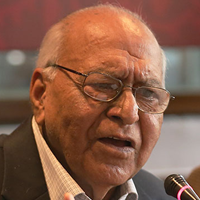
Articles of Gopi Chand Narang
Ma-baad-e-jadeediyat, Urdu Ke Tanaazur Mein
It has been several years since debates on postmodernism began in Urdu. Scholars know that modernism has played its historical role and lost its impact, and the premises upon which it was founded have been challenged. Sensitive writers who possess an
Taarikhiyat Aur Nayi Taarikhiyat: Adabi Theory Ka Eik Aham Mas'ala
If one were to ask whether literature is disconnected from history, everyone would say no; literature is hardly outside of history. But if it is true that literature exists within history, how do we generally come to accept that it is "autonomous" and
Sher-e-hasrat Ki Siyaasi Jehat Par Eik Nazar
At the turn of the century, Hasrat Mohani revived the culture of romance in the Urdu ghazal. The natural innocence and effortless ease with which he expressed love, along with the earthly and physical sensuality present in his romantic poetry—articulated
Faiz Ka Jamaaliyaati Ehsaas Aur Maniyaati Nizaam
(1) Ultimately, it is time that determines the true significance and greatness of poetry. In their own eras, Mir and Ghalib constantly complained about the world's lack of appreciation, yet as time passed, the mark of their greatness only grew
Urdu Aur Hindi Ka Lisaani Ishtiraak-2
When discussing the relationship between Urdu and Hindi, the question often arises: are they a single language or two distinct ones? Some scholars consider them two different registers of the same language. They blame this stylistic division on the new
Zabaan Ke Saath Kabeer Ka Jadooi Bartaao
Kabir holds an exceptionally high rank among the *Sant* (saint) poets. His birth is said to have taken place in Samvat 1455 Vikram (1398 CE). It is believed that he lived through the entire fifteenth century and a little beyond. He was born in Kashi.
Maraasi-e-anees Ka Tahzeebi Mutaalea
All the events and characters of the Urdu *marsiya* (elegy) are derived from the Islamic history of Arabia. None of it originates from India. Yet, the *marsiya* flourished in India to an extent never seen in the Arab world or Iran. While the Urdu *marsiya*
Adabi Tanqeed Aur Usloobiyaat
Some people have come to view stylistics as a bogeyman. The way stylistics is now being bandied about in Urdu, both appropriately and inappropriately, reveals that some people are genuinely terrified of it. Nevertheless, stylistics has established enough
Urdu Rasm-ul-khat: Eik Tareekhi Bahas
(Note: Some time ago, the magazine *Dost* published an Urdu translation of an article by Khwaja Ahmad Abbas, originally written in Hindi for *Dharmyug*. In it, Khwaja Sahib advised Urdu speakers to adopt the Devanagari script. *Dost* published a rejoinder,
Urdu Aur Hindi Ka Lisaani Ishteraak-1
The profound relationship between Urdu and Hindi is perhaps unparalleled by any other two languages in the world. Their foundation, structure, and framework are entirely identical—so much so that they are often considered a single language. Both originated
Urdu Adab Mein Ittihaad-pasandi Ke Rujhanaat (1)
The Urdu language is the point of confluence between Islamic and Indian civilizations, where the currents of both cultures merge to flow as a single new linguistic stream. In the garden of Urdu, just as one finds the tulip and the rose, the wild rose
Intizaar Husain Ka Fun: Mutaharrik Zahan Ka Sayyaal Safar
Intizar Husain is among the most important short story writers of our time. Through his deeply affecting allegorical style, he has introduced the Urdu short story to new artistic and thematic possibilities, seamlessly linking it to the *dastan* (classical
Ghalib Ka Jazba-e-hubb-ul-watani Aur Waqiyaat-e-san Sattaawan
Mirza Ghalib remained in Delhi from the very beginning to the end of the 1857 uprising. He chronicled the events of this period, from May 11, 1857, to July 21, 1858, in his Persian book, *Dastanbuy*. What Ghalib endured during the days of the rebellion
Urdu Ki Hindustani Buniyaad
Urdu has a profound connection with India and its languages. It was born and nurtured on this very soil. Sanskrit, or Indic, the ancient language of the Aryans, is considered its progenitor, separated by four linguistic generations. While India is home
Urdu Rasm-ul-khat: Tahzeebi-o-lisaaniyaati Mutaalia
Like language, a script belongs to the public, and everyone has the right to express an opinion about it. Consequently, those who write on this issue range from scholars to laypeople. However, most of these writings are driven by emotion; their purpose
Taraqqi-pasandi, Jadidiyat, Ma-baad-e-jadidiyat
None of these three—Progressivism, Modernism, or Postmodernism—is a personal issue for me. However, what is the current situation? What is happening, and where are we heading? Why do the writers of the new generation—especially the poets and fiction
Usloobiyaat-e-anees
Who has not praised the poetic perfection and eloquence of Anees? However, it was Shibli who first did him justice, paving the way for future generations to acknowledge his poetic greatness. Later criticism of Anees has largely followed the path shown
Urdu Adab Mein Ittihaad-pasandi Ke Rujhaanaat (2)
The crucial role that various festivals play in familiarizing people with one another's religious beliefs cannot be overlooked. The mutual interactions and social bonds between communities gave rise to a shared Indian culture. Influenced by this syncretic
Naya Afsana: Alaamat, Tamseel Aur Kahani Ka Jauhar
The New Short Story, which began in Urdu around 1955–60, is now safely stepping into its prime. In 1980, in my essay "The Urdu Short Story: Deviation from Tradition and a Moment of Reflection for Imitators," I specifically drew attention to the fact
Qissa Urdu Zabaan Ka
The story of the birth of the Urdu language is perhaps the most fascinating among Indian languages. Developing organically in bazaars, royal courts, and Sufi shrines, this language—then known as Rekhta—eventually reached such heights that other languages
Puranon Ki Ahmiyat
The Puranas are the oldest collections of Indian mythology and legends. No other source captures the Indian mind and temperament, the amalgamation of Aryan and Dravidian beliefs and ideologies, and the most ancient prehistoric eras quite like the Puranas.
Ma-baad-e-jadeediyat Kuchh Raushan Zaawiye
The debate on postmodernism—that is, the literary landscape following modernism—has now spread to almost all Urdu magazines and journals. Both new and established writers are participating in it. The echoes of these debates can also be found in older
Ma-baad-e-jadeediyat, Aalami Tanaazur Mein
"EVERYTHING IS POLITICAL. EVEN PHILOSOPHY AND PHILOSOPHIES. IN THE REALM OF CULTURE AND OF THOUGHT, EACH PRODUCTION EXISTS NOT ONLY TO EARN A PLACE FOR ITSELF BUT TO DISPLACE, WIN OUT OVER OTHERS." (ANTONIO GRAMSCI) The concept of postmodernism
Hindustani Fikr-o-falsafa Aur Urdu Ghazal
On the surface, the connection between the ghazal and philosophy seems rather strange. The ghazal is purely aesthetic poetry that takes flight on the wings of emotion and intuition; it is an expression of inner experiences and the intricacies of beauty
Firaq Gorakhpuri: Kahan Ka Dard Bhara Tha Tere Fasaane Mein
Firaq Gorakhpuri: What Depth of Pain Was Woven in Your Tale? By Gopi Chand Narang Firaq Gorakhpuri was one of those rare poets of our era who are born only once in centuries. His poetry possessed a remarkable ability to harmonize with the mysterious
Fiction Ki Sheriyaat Aur Saakhtiyaat
THE STRUCTURAL PATTERN OF THE MYTH UNCOVERS THE BASIC STRUCTURE OF THE HUMAN MIND, THE STRUCTURE WHICH GOVERNS THE WAY HUMAN BEINGS SHAPE ALL THEIR INSTITUTIONS, ARTIFACTS AND THEIR FORMS OF KNOWLEDGE. (LEVI STRAUSS) The structuralist methodology
Afsana-nigaar Premchand: Technique Mein Irony Ka Istemaal
I am not writing this essay as an apology; rather, it is driven by the realization that even forty-four or forty-five years after Premchand's passing, people have yet to accept him in his entirety. Radha Krishna, a discerning critic of Premchand, once
Manto Ki Nayi Padhat: Matn, Mamta Aur Khali Sunsaan Train
Saadat Hasan Manto passed away in 1955. Reading him again after such a long time, certain realizations clearly begin to surface in the mind. First and foremost, Manto was a rebel—a rebel against society, and a rebel against literature and art. He was