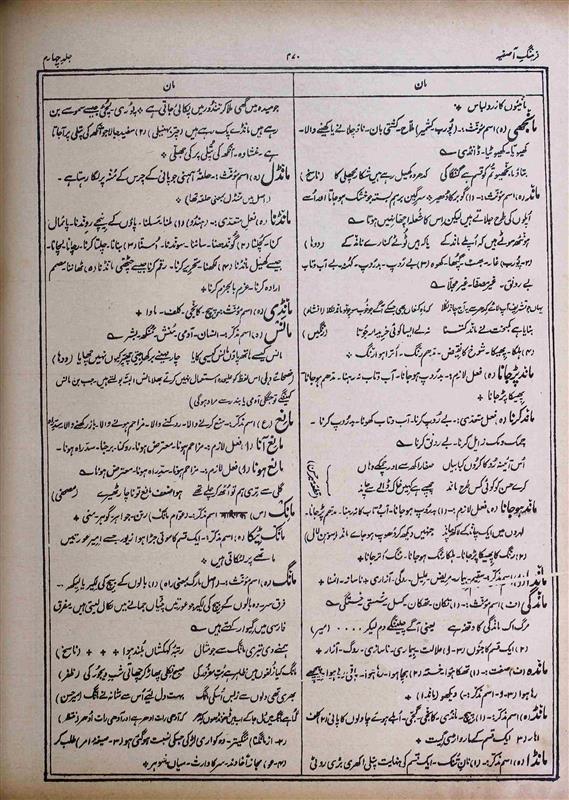
مانگ मांग māṅg
H مانگ मांग māṅg [conj. part. of māṅgnā; and=Prk. मग्गिअ=S. मृगयित्वा], part. Having asked, or begged, or borrowed, &c. (see māṅgnā):—māṅg-tāṅg kar kām ćalānā, To carry on (or manage) a work or business by borrowing from here and there:—māṅg denā, v.t. To ask for and give (to), to borrow for (another):—māṅg-kar, or māṅg-ke, conj. part.=māṅg, q.v.:—māṅg-lenā, v.t. To ask for; to borrow.
مانگ मांग māṅg
H مانگ मांग māṅg [Prk. मग्गो; S. मार्गः], s.f. A road, way, path (=māg, or mārg); division; parting of (the hair), the line on the top of the head where the hair is parted; an ornament of pearls or of gold worn on the parting line of the hair:—māṅg bharnā (-se), 'To fill up the māṅg,' to apply vermillion (or red lead, or pearls, &c.) to the parting of the hair; to marry (a woman):—māṅg-bharī, s.f. A woman with red-lead on the parting of the hair; a married woman, feme-covert;—a beloved wife;—māṅg-paṭṭī, s.f. The parting of the hair in the middle; dressing the hair;—māṅg-ṭīkā, s.m. An ornament worn along the parting of her hair (by a woman):—māṅg-jalī, s.f. A widow:—māṅg-ćiknī, s.f. A kind of bird:—māṅgćīrnā, or māṅg saṅwārnā, or māṅg nikālnā, To form the parting of the hair, to part the hair in the middle.
مانگ मांग māṅg v.n. fr. māṅg-nā, q.v.
H مانگ मांग māṅg (v.n. fr. māṅg-nā, q.v.), s.f. Want, request, demand;—betrothal; a betrothed damsel:—māṅg khulnā (-kī), A betrothal to become void; a betrothed wife (or husband) to die:—māṅg honā (-kī), A demand to exist (for), to be in request or demand.