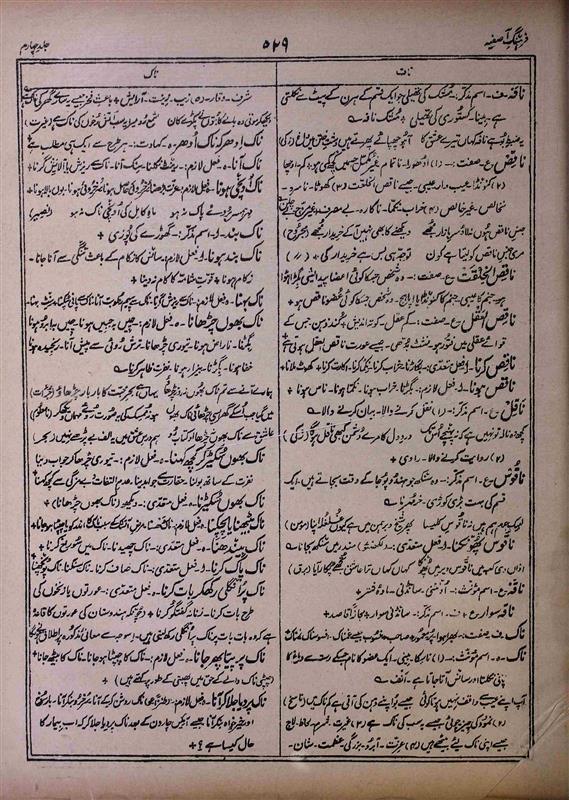
ناك नाक nāk
H ناك नाक nāk [Prk. नक्कं, or नक्का; S. नक्रं, or नक्रा], s.f. The nose;—(met.) a conspicuous or prominent person or thing;—honour; grace, ornament:—nāk ānā, or nāk bahnā (-kī), To have a running at the nose:—nāk utārnā, or nāk uṛānā (-kī), To take off, or to whip off, the nose (of); to disgrace (syn. nāk kāṭnā):—nāk-band, s.m. Nose-band (of a bridle):—nāk-bhauṅ ćaṛhānā, or sameṭnā, To turn up the nose and knit the brows:—nāk baiṭhnā or baiṭh-jānā, The nose to be or become flattened:—nāk bīṅdhnā (-kī), To pierce or bore the nose (of):—nāk pāk karnā, To blow the nose:—nāk-par uṅglī rakhkar bāt karnā, 'To put the finger on the nose when speaking' (as is the manner of women); to act like a woman; to be effeminate:—nāk-par pahiyā phir-jānā (-kisī-kī), 'A wheel to pass over the nose (of)'; the nose to become flat:—nāk-par ṭakā rakh-denā, 'To place the money on the nose'; to pay readily (for a thing):—nāk-par guṣṣa honā, or nāk-par mizāj honā, 'To carry (one's) anger, or temper, at the tip of the nose'; to be very irascible:—nāk pićaknā or pićak-jānā, v.n.=nāk baiṭhnā, q.v.:—nāk jhāṛnā, To blow the nose:—nāk ćaṛhānā, To turn up the nose (through contempt or pride); to show contempt (for, -par), to spurn;—to look angry, to be angry or displeased:—nāk ćane ćabwānā (kisī-ko), 'To make one chew gram with the nose;' to torment, worry, harass:—nāk-ćoṭī giriftār honā (with gen.), 'The nose and top-knot to be entangled or caught'; to be in great difficulties:—nāk ćhednā (with gen.), To bore the
nose (of):—nāk rakhnā, or nāk-sākh rakhnā (apnī), 'To keep (one's) nose'; to preserve (one's) honour; to have a good name:—nāk ragaṛnā, To rub the nose (against the ground);—to beseech very humbly:—nāk sakoṛnā = nāk ćaṛhānā, q.v.:—nāk sinaknā, or nāk ṣāf karnā, To blow the nose:—nāk-kā bāl, 'Hair of the nose';—one who is respected or honoured;—one who has influence over another:—nāk kāṭnā (-kī), To cut off the nose (of); to disgrace, dishonour:—nāk kāṭne-kā ḍar dikhānā, To hold (or holding) before one the threat of cutting off the nose; duress by menaces or threats:—nāk-kān kāṭnā (-ke), To cut off the nose and ears (of); to disgrace, dishonour:—nāk kaṭānā (apnī, or kisī-kī), To have or get the ears cut off; to disgrace, dishonour:—nāk kaṭnā, or nāk kaṭā honā (-kī), The nose (of a person) to be cut off; to be disgraced:—nāk-kī sīdh, s.f. The line of the nose;—adv. In a straight line with the nose; straight as an arrow; as the crow flies:—nāk ghisnā (apnī) = nāk ragaṛnā, q.v.:—nāk mārnā (-par), To spurn, contemn (i.q. nāk ćaṛhānā):—nāk malnā (with gen.), To rub the nose;—to twist the nose (of):—nāk-meṅ bolnā, To speak through the nose:—nāk-meṅ tīr ḍālnā (-kī), 'To pierce (one's) nose with an arrow'; to worry, harass:—nāk-meṅ dam ā-jānā (with gen.), 'The breath to come into (one's) nostrils'; to be greatly worried or harassed:—nāk-meṅ dam karnā or lānā (-kī), 'To cause the breath to come into the nostrils (of)'; to worry, plague, harass:—nāk na dī jānā, To be unable to put the nose (into a house, on account of the stench):—nāk-wālā, s.m. (f. -wālī), 'One having a nose'; an honourable man; a person of rank:—nākā-nāki, adv. Nose to nose:—nākoṅ-nāk, adj. & adv. Up to the nose, brimful, to the brim:—nākoṅ-nāk bharnā (-ko), To fill to the nose; to stuff, cram:—sutwāṅ nāk, A long thin nose:—suʼā-sī nāk, or suʼe-kī-sī nāk, A nose like a parrot's beak.
نکہت nak, hat for A. نکہة, fem. of nakh, inf. n. of نکه 'to breathe into the face of another
P نکہت nak, hat (for A. نکہة, fem. of nakh, inf. n. of نکه 'to breathe into the face (of another)), s.f. Smell of the breath;—anything odoriferous; perfume, odour.
نوك nok
P نوك nok, s.f. Point, tip, end; angle; nib (of a pen); beak, or bill (of a bird):—nok-jhok, or nok-ā-jhokī, or nok-ćok, or nok-ā-ćokī, s.f. Tugging and pulling, scrimmage;—talking by innuendoes; stinging allusions, sarcastic observations:—nok-dār, adj. Pointed:—nok-dār barmā, s.m. A pin-drill:—nok-dum bhāgnā, v.n. (colloq.) To show a clean pair of heels:—nok-ě-zabān, s.f. The tip of the tongue:—nok-ě-zabān, vulg. nok-zabān, or nok-zabānī, adv. On the tip of the tongue;—by heart:—nok-zabān karnā, v.t. To get by heart.
نکاح nikāḥ inf. n. of نکح 'to marry'
A نکاح nikāḥ (inf. n. of نکح 'to marry'), s.m. Matrimony, marriage, nuptials (the most honourable kind of marriage, though in Bengal the term is applied to a left-handed marriage, such as that of a widow, which is considered disreputable):—nikāḥ-ě-bewagān, s.m. Marriage of widows:—nikāḥ-paṛhāʼī, s.f. Marriage-fees:—nikāḥ paṛhānā or paṛhā-denā (-kā), 'To read the marriage-ceremony' (over), to tie the nuptial knot:—nikāḥ-ě-s̤ānī, s.m. A second marriage:—nikāḥ karnā, v.t. To marry, wed:—nikāḥ kar denā (-kā), To marry (a person to, -se,
another), to give (one) in marriage (to, -se):—nikāḥ-ě-mitʻat or mutʻa, or nikāḥ-ě-muwaqqat, s.m. A temporary marriage (very common among Muhammadans, especially when detained from home: it is celebrated with certain forms, and not considered disreputable; and though the marriage itself is null and void in law, the offspring are legitimate):—nikāḥ-meṅ lānā (-ko), To take in marriage, to marry:—nikāḥ-nāma, s.m. Marriage-contract:—arkān-ě-nikāḥ, s.m. Essentials of a marriage (viz. the proposal and consent):—sharāʼit̤-ě-nikāḥ, s.f. The conditions of a marriage (viz. discretion, puberty, and freedom of the contracting parties).
نيك नेक nek, नैक naik, or नेकु neku
H نيك नेक nek, नैक naik, or नेकु neku [prob. S. नेम+कः; or corr. fr. S. कणीकः; cf. nikkā], adj. & adv. Little, small; a little;—for a little while, for a short time.