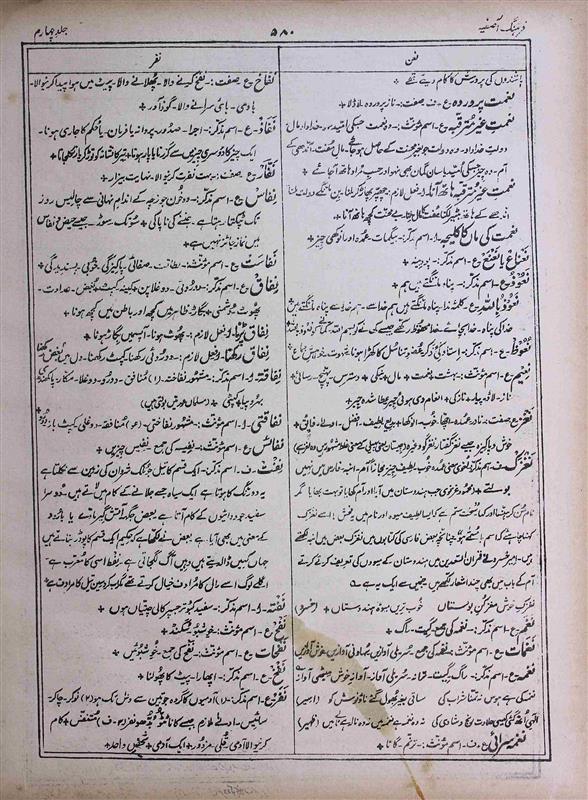
نفر nafar v.n. fr. نفر 'to flee,' c.;—orig. 'a crowd or body of men to which one belongs fleeing or going together,' but applied by the Persians to an individual
A نفر nafar (v.n. fr. نفر 'to flee,' &c.;—orig. 'a crowd or body of men (to which one belongs) fleeing or going together,' but applied by the Persians to an individual), s.m. A servant; a groom;—one person, an individual; one hand (e.g. tīn nafar, 'three persons, three hands; three'):—nafar-gaṭṭī faiṣala, s.m. Settlement of land-revenue, or taxes, &c., made with each individual cultivator himself, independent of any landholder (i.q. raʻīyat-wārī faiṣala).
نفر nafr inf. n. of نفر 'to be frightened and run away'
A نفر nafr (inf. n. of نفر 'to be frightened and run away'), s.f.(?) Running away in fright;—fright, terror.
نفور nufūr inf. n. of نفر 'to run away in terror'
A نفور nufūr (inf. n. of نفر 'to run away in terror'), s.m.(?) Running away in terror, fleeing;—excelling (in anything);—swelling (of the skin, &c.);—nafūr (v. adj. fr. the same verb), adj. Frightened, terrified, scared; fleeing (from);—averse (to); abhorring.
نفيِر nafīr
P نفيِر nafīr = P نفيري nafīrī s.f. A kind of trumpet (smaller than the karnā);—a clarionet;—a fife:—nafīrī-wālā, s.m. A trumpeter, &c.