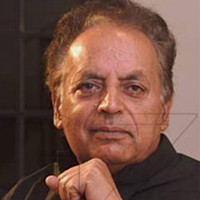
Profile of Mustansar Husain Tarar
Identity: An eminent travel writer, novelist, dramatist, columnist, and one of the most widely read contemporary literary figures of Pakistan.
Mustansar Hussain Tarar was born on 1 March 1939 in Lahore. His ancestral roots belong to a farming family from Gujrat, though Lahore remained the center of his life and literary activities. He spent his childhood in Lakshmi Mansion on Beadon Road, where the legendary Urdu short story writer Saadat Hasan Manto lived in the neighborhood. He received his early education at Mission High School, Rang Mahal, and Muslim Model High School, and later joined Government College. After completing his F.A., he traveled to Britain and various European countries, where he gained the opportunity to explore film, theatre, and literature from new perspectives. After spending nearly five years in Europe, he returned to Pakistan with a degree in Textile Engineering.
Mustansar Hussain Tarar experimented with several literary genres. His literary journey formally began with his 1957 visit to the Soviet Union, the account of which appeared in “London se Moscow Tak” and later in the novella “Fakhta.” However, he achieved lasting fame through his travelogue “Niklay Teri Talash Mein” (1971), which received immense appreciation from both readers and critics. This work introduced a new style to Urdu travel writing, blending vivid imagery, personal experience, humor, dialogue, and cultural observation. His notable travelogues include “Andalus Mein Ajnabi,” “Khana Badosh,” “K2 Kahani,” “Nanga Parbat,” “Chitral Dastan,” “Hunza Dastan,” “New York ke Sau Rang,” “Moscow ki Safaid Raatein,” “Alaska Highway,” and “Lahore se Yarkand Tak.” He shared a deep emotional connection with the northern areas of Pakistan, and in recognition of this bond, a lake there was named “Tarar Lake.”
Tarar also earned extraordinary recognition as a novelist. His novel “Pyar ka Pehla Shehar” became immensely popular and saw more than fifty editions. “Bahao” is regarded as his masterpiece, in which he creatively revived an ancient Indus Valley civilization through a unique linguistic and imaginative framework. “Raakh” is an important novel centered on the fall of Dhaka and the socio-political realities that followed. Other major novels include “Khas-o-Khashak Zamane,” “Ae Ghazal-e-Shab,” “Qila Jangi,” “Qurbat-e-Marg Mein Mohabbat,” and “Dakia aur Julaha.” His fiction presents history, civilization, memory, geography, and human psychology in a highly distinctive narrative style.
Alongside literature, Mustansar Hussain Tarar made remarkable contributions to television drama, acting, and hosting. He gained immense popularity as the first host of PTV’s morning show “Subah Bakhair,” through which he became famously known as “Chacha Ji.” He wrote several dramas, including “Aadhi Raat ka Sooraj,” and also appeared as an actor in numerous television productions. In later years, he continued hosting travel and social programs on different television channels. As a columnist, too, he developed a distinctive voice, and collections such as “Tarar Nama,” “Guzara Nahin Hota,” “Ullu Hamare Bhai Hain,” and “Karwan Saraye” reflect his wit, humor, and keen observation.
In recognition of his literary contributions, Mustansar Hussain Tarar was awarded the Presidential Pride of Performance. His novel “Raakh” received the Prime Minister’s Literary Award in 1999, and in 2002 he was honored with a Lifetime Achievement Award in Doha, Qatar.
Tagged Under
Authority Control :The Library of Congress Control Number (LCCN) : n85018185