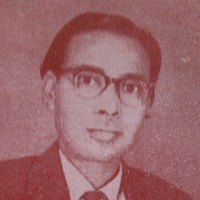
Profile of Salam Sandelvi
Pen Name : 'Salam'
Real Name : Abdussalam
Born : 25 Feb 1919 | Sandila, Uttar pradesh
Died : 17 Sep 2000 | Gorakhpur, Uttar pradesh
LCCN :n81055709
aa.e jo chand tinke qafas meñ sabā ke saath
maiñ ne unhīñ ko apnā nasheman samajh liyā
aae jo chand tinke qafas mein saba ke sath
main ne unhin ko apna nasheman samajh liya
Identity: Eminent critic, researcher, and poet
Dr. Abdus Salam Sandelvi, popularly known in literary circles as Salam Sandelvi, was born on 25 February 1919 in the village of Karna near the historic town of Sandila in Awadh. His father, Munshi Bakhtawar Ali, worked in the police department and deeply valued education. Under his guidance, Salam received careful educational training from an early age. After completing his initial education at home, he was admitted to the Khanqah School in Sandila, from where he passed the fourth grade in 1930. Later, he completed his Urdu Middle and English sixth-grade examinations from Town School, Sandila.
For higher education, he moved to Lucknow, where he passed High School from Ameer-ud-Daula Islamia School in 1937 and Intermediate from Christian College, Lucknow in 1939. In 1942, he received C.T. training from Government Training College, Lucknow. He subsequently earned degrees in B.A., LL.B., M.A. in Urdu, M.A. in History, and later M.A. in Persian from Lucknow University. In 1957, he completed his PhD on the subject of “Urdu Rubaiyat”, and in 1964 obtained a D.Litt. for his research on “Nature Description in Urdu Poetry.”
Salam Sandelvi began his professional career in teaching. Initially, he served at Faiz-e-Aam School Kanpur, Industrial School Lucknow, and Mohan Lal Moria School. In 1948, he became the Principal of Sunni Higher Secondary School, Lucknow, where he served for nearly ten years. In 1959, he joined the Department of Urdu at Gorakhpur University as a lecturer and later retired as Reader. Gorakhpur remained the center of his academic and literary activities throughout his life.
Salam Sandelvi was simultaneously a poet, critic, researcher, and teacher. He began writing poetry in 1940 and later became a disciple of Maulana Afqar Mohani Warsi. His poetic collections include Sagar-o-Meena, Nakhat-o-Noor, Shaam-o-Shafaq, Raqs-e-Jaam, and Titliyan, a collection of poems for children. His poetry reflects classical elegance, intellectual depth, and aesthetic delicacy.
In the fields of criticism and research, Salam Sandilvi rendered remarkable services. His important prose works include Adab ka Tanqeedi Mutala, Adabi Ishare, Urdu Rubaiyat, Ganjina-e-Maloomat, Zakhira-e-Maloomat, and Kaabe Mein Sanamkhana. He discussed literary and critical issues in a style that was both scholarly and accessible. His criticism is marked by intellectual clarity, balanced judgment, and lucid expression.
Salam Sandelvi also authored Tarikh-e-Adabiyat-e-Gorakhpur, a significant work documenting the literary history of Gorakhpur along with detailed accounts of its prominent poets and writers. He also wrote his autobiography titled Qaid-e-Hayat, which offers not only reflections on his personal life but also a vivid portrayal of the intellectual, cultural, and literary milieu of his era.
Death: Salam Sandelvi passed away on 17 September 2000 in Gorakhpur.
Authority Control :The Library of Congress Control Number (LCCN) : n81055709