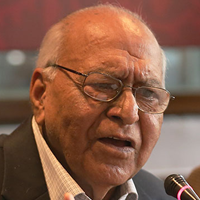

Why Was Hasrat Mohani's Political Poetry Ignored?
While Urdu criticism highly praised Hasrat Mohani's romantic poetry, it intentionally or unintentionally ignored his anti-imperialist and rebellious political verses.
aaj ik aur baras biit gayā us ke baġhair
jis ke hote hue hote the zamāne mere
While Urdu criticism highly praised Hasrat Mohani's romantic poetry, it intentionally or unintentionally ignored his anti-imperialist and rebellious political verses.
Despite sharing a common foundation, Urdu and Hindi have evolved through various stages to become two distinct and independent languages; therefore, it is not necessary for them to share the same script.
Hasrat Mohani beautifully expressed his rebellious and political sentiments against British imperialism by utilizing the traditional romantic symbols and metaphors of the ghazal.
The Urdu script is entirely tailored to Indian phonetics. The addition of sixteen symbols to represent Hindi's aspirated and retroflex sounds distinguishes it from Arabic and Persian, making it a truly indigenous script.
This article sheds light on the incorporation of the Indian tone in Firaq Gorakhpuri's ghazals and the revival of the classical tradition of the God of Poetry, Mir Taqi Mir.
This article presents a comparative analysis of the phonetic systems in the poetry of Mir Taqi Mir, Mirza Ghalib, and Allama Iqbal, illustrating how Iqbal combined Mir's musicality with Ghalib's grandeur.
This article critically examines the romantic concept of 'originality' in literature and the claim of 'objectivity' in historical studies, illustrating that an author's mind is never entirely independent of their culture.
This article analyzes the phonological rhythm in Allama Iqbal's poetry, specifically focusing on the abundant use of sibilant and continuant sounds and the atmosphere they create.
This article explores how Allama Iqbal minimized the use of heavy aspirated and retroflex sounds in his Urdu poetry, and examines the profound impact this had on his poetic style.
This article examines the centuries-old debate between literature and history, highlighting the conflict between Plato's theory of mimesis and Aristotle's formalism, and its impact on Urdu literature.
How Amir Khusro, the Sufi mystics, and the saints of the Bhakti movement made the shared language of Urdu and Hindi a medium to reach the hearts of the people.
Using the terminology of his weaving profession, Kabir transformed the complex philosophy of human life, the soul, and the universe into a profoundly beautiful and unique metaphor.
This article covers Firaq's life, his humanism, his role in the freedom movement, and the expression of human suffering in his poetry.
This piece explores the depiction of the Indian woman, motherhood, and domestic love in Firaq Gorakhpuri's renowned collection of quatrains, 'Roop'.
This article discusses Firaq Gorakhpuri's views on language, the connection between Urdu and Khari Boli, and his opposition to artificial language.
An overview of the evolutionary stages of the shared language of Urdu and Hindi, from the centrality of Delhi during the Ghurid era to its migration to the Deccan during the reign of Muhammad Tughlaq.
This article explores the psychological struggles of early Urdu, the dominance of Persian, and the revolutionary impact of Wali Dakni's poetry, which elevated Urdu to the status of a formal literary language.
This article discusses how Faiz Ahmed Faiz created a unique semantic system by infusing the worn-out vocabulary of the classical ghazal with new social and political meanings.
This article analyzes the imagery of night, moonlight, and loneliness in Faiz's poetry, which creates a distinct and intense aesthetic atmosphere in his work.
This piece explores the themes of 'pain', 'memory', and 'longing' in the poetry of Faiz Ahmed Faiz, which emerge not merely as personal sorrow, but as a profound creative and universal force.
By rejecting traditional and classical poetics, Kabir laid the foundation for a new, public poetics, which served as a rebellion against the oppressive social system of his time.
Progressive poets, particularly Majrooh Sultanpuri and Faiz Ahmad Faiz, are often considered the pioneers of introducing political themes into the ghazal, but historical facts attribute this milestone to Hasrat Mohani.
An overview of the shared idioms, proverbs, and compound words in Urdu and Hindi, reflecting the deep cultural affinity between the two languages.
This article explores whether Faiz's political poetry will lose its significance over time, illustrating how his aesthetic richness makes his work timeless.
This article explores the influence of English Romanticism and Sanskrit Kavya on Firaq's poetry, along with his universal concept of beauty and love.
The historical and linguistic journey of the origins of the Urdu and Hindi languages, from the Indic language to the Apabhramshas and the emergence of 'Hindavi' during the Ghaznavid period.
A linguistic analysis of the striking phonetic, syntactic, and morphological similarities between Urdu and Hindi.
This article discusses the contributions of Fort William College, focusing specifically on the linguistic balance in Mir Amman's 'Bagh-o-Bahar' that bestowed simplicity and fluency upon Urdu prose.
This article examines the three semantic levels of Urdu poetry (romantic, mystic, and political) through the lens of structuralist criticism, highlighting how Faiz Ahmed Faiz imbued traditional symbols with revolutionary meanings.