- Index of Books 180696
-
-
Book Categories
-
Activities89
Children's Literature1988
Drama921 Education347 Essays & Profiles1377 Fiction1653 Health108 History3344Humorous604 Journalism201 Language & Literature1145
Letters726 Life Style30 Medicine974 Movements268 Novel4278 Political349 Religions4769Research & Criticism6699Short-story2670 Sketches236 Social issues111 Sufism / Mystic2014Text Books440 Translation4190-
Book Categories
- Bait Bazi14
- Catalogue / Index4
- Couplets68
- Deewan1254
- Doha49
- Epics100
- Exegesis186
- Geet63
- Ghazal1265
- Haiku11
- Hamd59
- Humorous31
- Intikhab1583
- Keh mukarni6
- Kulliyat571
- Mahiya20
- Majmua4874
- Marsiya387
- Masnavi736
- Musaddas44
- Naat590
- Nazm1209
- Others84
- Paheli14
- Qasida179
- Qawwali16
- Qit'a67
- Quatrain264
- Quintuple15
- Rekhti12
- Remainders16
- Salaam34
- Sehra12
- shahr-Ashob, Hajw, Zatal Nama17
- Tareekh-Goi26
- Translation75
- Wasokht24
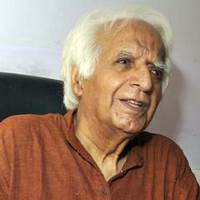
Profile of Joginder Paul
Identity: A distinguished and unique modern Urdu fiction writer, a sensitive interpreter of human psyche and social realities, also known for short-short stories.
Joginder Pal is a significant figure in the history of Urdu fiction who transformed storytelling from mere narration into a medium for exploring human consciousness, socio-economic issues, and psychological complexities. For him, fiction is an inner experience, expressed through characters with such depth that readers can feel the movement of the human soul.
He was born on 5 September 1925 in Sialkot. He completed his early education at Ganda Singh High School and graduated from Murray College, Sialkot. After the Partition of India, his family migrated to Ambala, where they faced severe financial hardship. Despite being an M.A. English student, he worked in a dairy, bringing milk from distant villages early in the morning. This phase instilled in him a strong sense of responsibility and resilience.
In 1948, he moved to Kenya, where he spent fourteen years, which he described as a period of “exile.” The experiences of racial discrimination, exploitation, and social injustice deeply influenced his writing, reflected in his collection “Dharti Ka Kaal.”
He returned to India in 1963, joined the teaching profession, and later became a principal. In 1978, after retirement, he settled in Delhi and devoted himself entirely to writing.
His fiction is marked by narrative innovation, stream of consciousness, and symbolic depth. He focuses more on the inner life and psychology of characters rather than rigid plots. His characters appear real and deeply human.
Major themes in his work include poverty, class conflict, migration, Partition trauma, and the decline of human values. His notable stories include “Afreed (Ifrit)”, “Chor Sipahi”, “Boo”, “Gaadi”, “Be-Gor”, “Hari Kirtan”, and “Panahgah.”
He never aligned himself with any literary movement, choosing instead to follow his inner voice. His wife, Krishna Pal, played an important role in his literary journey.
Joginder Pal remains a luminous figure in Urdu literature, who elevated fiction through human sensitivity, intellectual depth, and creative honesty.
Death: 23 April 2016
Tagged Under
Authority Control :The Library of Congress Control Number (LCCN) : n83184800
join rekhta family!
-
Activities89
Children's Literature1988
-