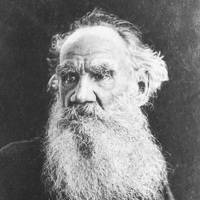
Profile of Leo Tolstoy
Pen Name : 'Tolstoy'
Real Name : Lev Nikolayevich Tolstoy
Born : 09 Sep 1828
Died : 20 Nov 1910 | Russia
Identity: One of the world's greatest Russian novelists, playwrights, philosophers, a staunch advocate of non-violence, and the creator of global masterpieces like 'War and Peace'.
Leo Tolstoy (Lev Tolstoy) was born on September 9, 1828, into an aristocratic family in Yasnaya Polyana, located in the Tula region of Russia. His full name was Lev Nikolayevich Tolstoy.
At the tender age of nine, Tolstoy lost both his parents, after which he and his siblings were raised by various relatives. In his childhood, he received education at home from French and German tutors.
At the age of 16, he enrolled in the Department of Law and Oriental Languages at Kazan University. However, his teachers considered him an 'incapable and careless' student. Disheartened by the negative attitudes of his teachers and fellow students, he left his education incomplete without obtaining a degree and returned to his ancestral estate.
In 1849, he opened a school on his estate for the welfare and education of peasants' children, which soon failed. Following this, he moved to Moscow and Saint Petersburg, where he deeply studied the plight and social life of Russian peasants.
In 1851, he joined the army and participated in the war against the Turks (the Crimean War). During his military service, he wrote his first autobiographical novel, "Childhood", which was published in 1852. He later continued this trilogy with "Boyhood" and "Youth".
His book "Sevastopol Sketches", based on his firsthand experiences of the horrors of war and the siege, brought him prestigious recognition in the literary world. Soon, growing weary of military life, he returned to Saint Petersburg and established friendly relations with contemporary writers like Ivan Turgenev.
In 1857 and 1860, Tolstoy traveled extensively across Western Europe to understand modern European civilization closely. Upon returning from Europe, he married in 1862 and spent the next fifteen years continuously on his estate. This was the most fertile period of his life, during which he created two of the world's greatest novels:
War and Peace: Written between 1865 and 1869, it was deeply rooted in his own military experiences.
Anna Karenina: Written between 1875 and 1877.
After 1876, Tolstoy went through a severe internal and spiritual crisis. Rejecting the stagnant and feudal doctrines of the Russian Orthodox Church, he formulated his own philosophy of a Christian renaissance, details of which he penned in his monumental book, "A Confession".
He rejected the concept of private property, fiercely condemned the exploitation of humans by humans, and through his pen and speech, declared democracy, equality, fraternity, and non-violence as his creed. His philosophies later profoundly influenced figures like Mahatma Gandhi.
Tolstoy's influence among the Russian public and worldwide had grown to such an extent that the Russian government did not dare to take any action against him despite his revolutionary views, though the orthodox Russian Church excommunicated him in 1901.
He wished to live a simple life according to his ideals, but his family members (especially his wife) opposed his ascetic lifestyle. Consequently, heartbroken, he left his home in his old age, distributed all his wealth and estate among peasants and laborers, and renounced everything except the clothes on his back.
Tolstoy was not just a novelist but also a playwright, essayist, reformer, and philosopher. His other significant works include "Resurrection", "The Death of Ivan Ilyich", "The Kreutzer Sonata", and numerous moral and social essays.
Death: On November 20, 1910, this great reformer and writer passed away in a state of destitution on the platform of a remote railway station (Astapovo) in Russia.
USEFUL LINKS : | https://en.wikipedia.org/wiki/Leo_Tolstoy