For any query/comment related to this ebook, please contact us at haidar.ali@rekhta.org
About The Author
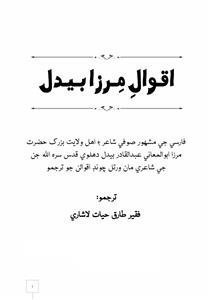
Identity: Renowned Persian Poet, Sufi Thinker, Leading Exponent of the Indian Style (Sabk-e-Hindi), and Famous as “Abu al-Ma‘ani”
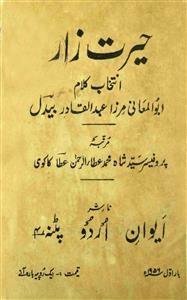
Mirza Abdul Qadir Bedil, also known as Bedil Dehlavi and Bedil Azimabadi, was born in 1644 CE (1054 AH) in Azimabad (present-day Patna, India). He belonged to the distinguished Barlas clan of Chagatai origin. His ancestors originally hailed from the historic city of Bukhara in Transoxiana and later migrated to India. His father, Mirza Abdul Khaliq, was a former Turkic soldier.
Bedil lost both his parents at an early age. His father passed away when he was about four and a half years old, and his mother died when he was six. He was subsequently raised by his uncle, Mirza Qalandar, who encouraged him to pursue independent study, reflection, and the company of scholars and Sufi saints rather than formal schooling. This upbringing laid the foundation for his extraordinary intellectual and spiritual development.
Bedil devoted himself to the study of the great masters of Persian literature, particularly Rudaki, Amir Khusrau, and Jami. He was not only a poet but also a scholar of philosophy, Sufism, medicine, astrology, jafr, geomancy, music, and history. His poetry is distinguished by its depth of thought, complexity of meaning, philosophical insight, and mystical vision. For this reason, he is widely regarded as the greatest representative of the Sabk-e-Hindi (Indian Style) in Persian poetry.
He spent most of his life in Delhi, where his gatherings became a center for scholars, Sufis, poets, and intellectuals. His personality combined learning, spirituality, humility, and moral excellence, attracting admirers from all walks of life. Although several Mughal rulers, including Emperor Aurangzeb Alamgir, admired his poetry, Bedil consistently avoided courtly panegyrics and remained independent of royal patronage.
His major works include Diwan-e-Bedil, Chahar Unsur, Irfan, Tilism-e-Hairat, Muhit-e-Azam, Tur-e-Ma‘rifat, and numerous masnavis. His writings are considered among the finest examples of philosophical and mystical Persian literature. His influence extended across the Indian subcontinent, Afghanistan, and Central Asia. Allama Iqbal greatly admired his intellectual and spiritual stature, while Mirza Ghalib drew significant inspiration from his poetic style.
Death: Mirza Abdul Qadir Bedil passed away in Delhi in 1720 CE. His resting place is located opposite Purana Qila on Mathura Road, near the Major Dhyan Chand National Stadium, at a site known today as Bagh-e-Bedil (Garden of Bedil).
For any query/comment related to this ebook, please contact us at haidar.ali@rekhta.org