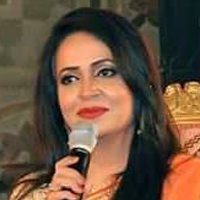
Profile of Ambareen Haseeb Ambar
Pen Name : 'Ambar'
Real Name : Ambareen Ansari
Born : 23 Jun 1981 | Karachi, Sindh
Relatives : Sahar Ansari (Father)
ham to sunte the ki mil jaate haiñ bichhḌe hue log
tū jo bichhḌā hai to kyā vaqt ne gardish nahīñ kī
hum to sunte the ki mil jate hain bichhDe hue log
tu jo bichhDa hai to kya waqt ne gardish nahin ki
Ambareen Haseeb Ambar is a prominent Urdu poet, writer, and critic of the younger generation. Her poetry is marked by new and innovative ideas, deep intellectual insight, and a keen awareness of contemporary issues. Her deep concern for and reflection on the present world lend her poetry a distinctive and delicate quality. In addition to poetry, she has written numerous critical essays and literary features and has also worked on social issues concerning the younger generation. Her writings have also appeared in various newspapers.
Ambareen Haseeb Ambar completed her Master's degree in Urdu Literature from the University of Karachi, securing first position, and pursued her Ph.D. in the same subject. She began composing poetry informally at the age of nine and continued to experiment with shaping words into poetry. In 1991, after reading one of her poems, Raffat Siddiqui advised her to take poetry seriously and suggested that she also seek guidance from her father. Interestingly, her father was unaware at the time of her inclination towards poetry. She formally began writing after her marriage in 1995. Her husband appreciated her literary interest and strongly encouraged her to pursue poetry seriously.
According to Ambareen Haseeb Ambar, she inherited her poetic talent, although personal interest plays a fundamental role in developing and using this ability. She grew up in a household where well-known personalities frequently visited, but she was the only one who became seriously inclined towards poetry. She regards poetry as a serious and serene pursuit amid the turmoil of material life, and believes that only a person for whom poetry becomes a matter of life can continue the creative journey. She considers changing social norms, the transformation of the metaphysics of life, and the decline of values among the important concerns of the contemporary age. In her view, it is difficult for a poet to absorb these changes while maintaining harmony between the inner and outer worlds.
Her poetry explores themes such as the relationship between human beings and the universe, the relationship between human beings and God, the search for new meanings, women's issues, social concerns, and human psychology. She does not consciously or deliberately incorporate women's issues into her poetry; rather, these experiences find their way into her work as a spontaneous expression of her mind. As a woman, she believes that she can experience certain aspects of life that men may never be able to imagine. Her poetry also reflects her effort to understand the universe, her relationship with its Creator, and the social and psychological attitudes of people.
In her view, a poet draws inspiration from many sources, with the experiences of life being among the most important. When she began writing poetry in 1991, the situation in Karachi inspired her to express herself. According to her, the question of why the world is not as it ought to be creates a lasting sense of pain within a poet. Various events have also influenced her poetic journey. The 2005 earthquake, for instance, inspired her to write a poem, which was her first poem to be published in a newspaper.
Ambareen Haseeb Ambar has never regarded any poet as her ideal, not even her father. Her father always encouraged her to excel in every field of life. She considers genuine creative talent to be an integral part of a poet's own personality and does not regard imitation of another poet as a substitute for it. She has read and enjoyed the works of many poets but has never attempted to imitate any of them.
Regarding the social status of poets, she observes that there was a time when poets were regarded as insane, unserious, and detached from the real world. However, poets changed this perception through their conduct and work. Poetry was once considered a non-serious profession, but scholars such as Dr. Peerzada Qasim demonstrated that poets are rational and serious people who can undoubtedly bring about change in the world through their enlightened minds and loving hearts. Today, poets enjoy a respected position in society.