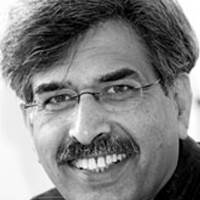
Profile of Jawayd Anwar
Jawayd Anwar was born on 18 April 1959 in the Islampura area of Lahore, Punjab, Pakistan. He belonged to the Bhatti family that migrated from eastern Punjab to Pakistan after the Partition of India in 1947. His father, Anwar Ali Bhatti, served as a civil servant in the Punjab Irrigation Department, while his mother, Nasir Akhtar, was originally from Jalandhar. Anwar spent most of his childhood in Shahinabad, Sargodha. He received his early education at a government primary school in Sargodha and later studied at Punjab Medical College in Faisalabad and the Oriental College in Lahore. After completing his MBBS, he worked as a physician at Lahore General Hospital and later at Allama Iqbal Medical College. He was also a qualified psychiatrist and was fluent in Urdu, English, German, and Persian.
Anwar developed an interest in Urdu poetry during his teenage years. While living in Sargodha, he came into contact with notable literary figures such as Khurshid Rizvi, Ghulam-us-Saqlain Naqvi, and Wazir Agha, who influenced his literary development. He began writing poetry around the ninth or tenth grade. Anwar is particularly recognized for his contribution to the genre of nazm, and he is considered an important voice in modern Urdu poetry.
His first poetry collection, Shahr Mein Shaam (Evening in the City), was published in 1991. His other works include Bheriye Soay Nahin and Ashkon Mein Dhanak. His poem Ham Ke Hero Nahin gained considerable recognition in literary circles. He also co-authored the book Qahqaha Insan Nay Ijad Kiya with Masood Qamar and Hussain Abid. Some of his unpublished poems were posthumously compiled and published in 2016 under the title Barzakh Kay Phul.
Jawayd Anwar passed away on 25 November 2011 in Lahore due to a sudden heart attack. His death was widely mourned in literary circles, and several commemorative events were held in his memory.