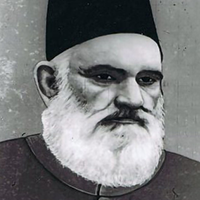
Profile of Mohsinul Mulk
Pen Name : 'Mohsinul Mulk'
Real Name : Syed Mehdi Ali
Born :Etawah, Uttar pradesh
Died : 16 Oct 1907 | Shimla, Himachal Pradesh
Identity: The soul of the Aligarh Movement, a close confidant and successor of Sir Syed Ahmed Khan, former High Secretary of Hyderabad State, and a distinguished Urdu prose writer.
Mohsin-ul-Mulk was born in 1837 in Etawah, where he also received his early education. His original name was Syed Mehdi Ali; however, after being honored with the title 'Mohsin-ul-Mulk', people largely forgot his birth name and began addressing him by this title. He was the son of Mir Zamin Ali, and his family belonged to the Sadat-e-Bareha lineage.
He began his career in the collectorate department and progressed through the patronage of Mr. Hume (the Collector). Following the 1857 uprising, he served as a Peshkar and later as a Sarishtedar. In 1861, he was appointed Tehsildar; it was during this period that he authored two significant books in Urdu: Qanun-e-Maal (Land Revenue Law) and Qanun-e-Faujdari (Criminal Law). He also penned Aayat-e-Bayyinat, a book concerning religious beliefs.
In 1867, he became the Deputy Collector in Mirzapur. Subsequently, Sir Salar Jung I of Hyderabad acquired his services, setting his initial salary at 1,200 rupees, which later increased to 1,500 rupees. He was also conferred with the title 'Nawab Munir Nawaz Jang'. In 1876, he became the Revenue Secretary and eventually rose to the position of Political Secretary. At that time, he held a 'Seh-Hazari' rank (rank of 3,000) with a salary of 3,000 rupees.
He also gained expertise in the field of minerals. During this period, he established relations with the British Prime Minister, William Ewart Gladstone. By then, Sir Syed Ahmed Khan’s movement had gained momentum. Initially, he remained distant from Sir Syed, but gradually became one of his closest associates. Sir Syed also highly valued his abilities and stature. It is noteworthy that he spent the rest of his life working alongside Sir Syed. Following the death of Syed Mahmood in 1898, he was elected as the Secretary of Aligarh College.
Nawab Mohsin-ul-Mulk served the college at a time when its financial difficulties were at their peak. An embezzlement of one hundred thousand rupees had occurred, and the college was drowning in debt. Mohsin-ul-Mulk remained proactive and collected donations, which not only improved the college's condition but also successfully cleared all debts.
It is also important to remember that during his stay in Hyderabad, he proposed making Urdu the official language of the state instead of Persian and succeeded. His articles published in the journal Tehzeeb-ul-Akhlaq proved highly influential for the common Muslims due to their simplicity, elegance, and scholarly thought. Maulana Hali openly acknowledged that his writings ignited passion and a spirit of action among Muslims. Shibli Nomani also praised the qualities of his prose. A collection of his letters has been published under the title Majmua-e-Rasail.
Death: He passed away in 1907 in Shimla but was brought to Aligarh and buried alongside Sir Syed Ahmed Khan.
USEFUL LINKS : | https://en.wikipedia.org/wiki/Mohsin-ul-Mulk