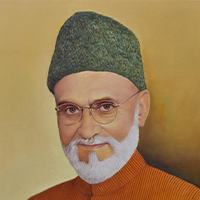
Profile of Muhammad Baqar Shams
Maulana Syed Muhammad Baqar Shams (August 10, 1909 – January 6, 2007) was a distinguished Urdu poet, critic, researcher, historian, writer, and educationist. Born on August 10, 1909 (23 Rajab 1327 AH) in Jaunpur, India, he passed away on January 6, 2007 (16 Dhul Hijjah 1427 AH) in Karachi, Pakistan. He belonged to a distinguished scholarly and religious family whose legacy extended across India and Pakistan. His father, Maulana Syed Sibt-e-Hussain Sahib Qibla Taba-Sarah, was a renowned Mujtahid, while his mother was the daughter of Malaaz-ul-Ulama Maulana Syed Abu Al-Hassan, also known as Maulvi Bachchan Sahib Qibla Taba-Sarah. Maulana Shams received his education at Lucknow University, where he earned the Dabeer-e-Kamil qualification, and also studied medicine at Munmba-e-Tib College, Lucknow. He was proficient in Urdu, Persian, and Arabic and was familiar with Hebrew and English.
Maulana Shams began writing poetry in 1923, at the age of fourteen, and started publishing literary articles and essays in 1926, at the age of seventeen. Throughout his life in India and Pakistan, he remained devoted to research, literary criticism, creative writing, composition, and educational reform. His literary and scholarly works covered poetry, history, language, literature, and religion. His notable publications include Shikast-e-Aaina (1928), Falsafa-e-Khayyam (1937), Durr-e-Manzoom (1937), Lucknow Ki Zaban (1955), Tareekh-e-Lucknow (1972), Shuoor-e-Shairi (1974), Shabab-e-Lucknow (1975), Lucknow Ki Shairi (1978), Intikhab-e-Diwan-e-Javed (1978), Lucknow Ki Tehzeeb (1982), Nigaris hat-e-Rang Rang (1989), Tareekh-e-Zaban-e-Urdu (1991), Tanqeedi Mabahis (1995), Aasaar-e-Shams (1998), and Panj Aahang (1999).
His book Falsafa-e-Khayyam, published by Sarfaraz Press, Lucknow, in 1937, presents a philosophical study of the rubaiyat of the eleventh-century Persian polymath Omar Khayyam. The work made a significant contribution to literary and philosophical scholarship and remained part of the Bachelor of Arts and Dabeer-e-Kamil curricula at Lucknow University for many years. His literary articles and essays appeared in several prominent newspapers and journals, including Daily Sarfaraz and Haqaiq Magazine of Lucknow, Nigar, edited by Niaz Fatehpuri, Aks-e-Latif, edited by Mukarram Lucknowi, and Tulu-e-Afkar, edited by Hussain Anjum.
Maulana Shams maintained close associations with numerous eminent literary figures, including Arzoo Lakhnavi, Dr. Ahsan Farooqui, Dr. Shaukat Sabzwari, Aziz Lakhnavi, Safi Lakhnavi, Hussain Anjum, Josh Malihabadi, Maulana Ali Naqi, Mirza Jafar Ali Khan Assar, Mirza Kazim Hussain Mehshar, Mirza Muhammad Hadi Aziz, Mirza Muhammad Hadi Ruswa, Mushfiq Khawaja, Nadeem Sitapuri, Niaz Fatehpuri, Professor Masood Hasan Adeeb, and Sahir Lakhnavi.
In recognition of his extensive contributions to literature, history, research, and criticism, Maulana Shams received numerous honorary titles from distinguished literary figures. These included Chabuk-Dast Mubassir (Adroit Commentator), Muslih-ul-odaba (Advisor to Men of Letters), Adeeb-e-Dauran (Author of His Time), Majmua-e-Kamalat (Collection of Perfections), Azmat-e-Zaban-o-Bayan Ke Alam-Bardar (Flagbearer of Language and Expression), Nabigha-e-Rozgar (Genius of the Age), Muarrikh-e-Kabir (Great Historian), Azeem Muhaqqiq (Great Researcher), Aabru-e-Lucknow (Pride of Lucknow), Ustad-ush-Shuara (Master of Poets), Allama-e-Asr (Scholar of the Age), Raees-ut-Tahreer (Prince of Writing), Adeeb-e-Shaheer (Renowned Writer), Fazil-e-Yagana (Peerless Scholar), Muhaqqiq-e-Yagana (Unrivalled Researcher), Naqid-e-Baseer (Visionary Critic), and Sahib-e-Usloob Musannif (Writer Endowed with a Distinctive Style).
Beyond literature and scholarship, he also took a keen interest in medicine and hunting. His enduring contributions to Urdu literature, historical research, literary criticism, and education established him as a significant intellectual figure of the Indian subcontinent.