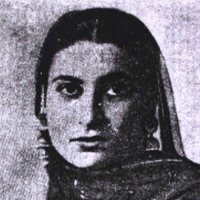
Profile of Qudsiya Zaidi
Identity: Translator, theatre practitioner, children’s writer, and a pioneering cultural figure of Hindustani Theatre
Qudsia Zaidi was born on 23 December 1914 in Delhi. Her original name was Umt-ul-Qudoos, though during her college years teachers and classmates commonly called her “Umatul” for convenience. Later, she adopted the name “Qudsia.” She was the younger daughter of Khan Bahadur Abdullah Sahib, a senior police officer in Delhi who belonged to a Kashmiri Brahmin family.
Qudsia lost her mother when she was barely two or three years old, and a few years later her father also passed away. She was then brought up in Lahore by her elder sister Zubeida and her brother-in-law, the celebrated Urdu humorist and intellectual Patras Bukhari. Patras Bukhari played a decisive role in shaping her literary taste, cultural sensibility, and interest in theatre. She graduated from the renowned Kinnaird College, Lahore.
In 1937, she married Colonel Bashir Hussain Zaidi. Their marriage was considered highly progressive for its time, as the couple chose each other despite initial family hesitation. Colonel Zaidi was associated with the princely state of Rampur and later moved to Delhi after becoming a member of the Constituent Assembly. Their marriage provided Qudsia with complete freedom to pursue her literary, cultural, and intellectual interests.
After settling in Delhi, Qudsia Zaidi’s home became a vibrant gathering place for writers, poets, painters, and intellectuals. During this period, she came into close contact with the noted cultural activist Kamaladevi Chattopadhyay, who further inspired her passion for theatre. In 1954, she met the legendary theatre director Habib Tanvir, and together they founded the “Hindustani Theatre,” one of the earliest professional urban theatre companies in post-independence India.
Qudsia Zaidi envisioned a theatre rooted in Indian culture, traditions, and folk life rather than blind imitation of the West. She personally devoted herself to every aspect of theatre-building, including arranging land, offices, rehearsal spaces, and artist training. The first rehearsals of Habib Tanvir’s iconic play Agra Bazaar were held at her residence. Hindustani Theatre later became a nurturing platform for several major artists, including M. S. Sathyu, Yunus Parvez, Irshad Panjatan, Monica Mishra, Shyam Arora, and Shiv Sharma.
Qudsia Zaidi was deeply committed to children’s literature and intellectual development. Dr. Zakir Husain strongly encouraged her literary activities for children. Her husband even established a publishing house called Kitabi Duniya to ensure the quality publication of children’s books. She actively participated in Shankar’s Weekly Children’s Art Competitions and the Book Trust. She also dramatized Imtiaz Ali Taj’s stories into the celebrated series Chacha Chhakkan ke Drame, which remain popular among children even today.
Although Qudsia Zaidi did not write many original plays, her translations and adaptations of world classics, English dramas, and Sanskrit plays significantly enriched Urdu-Hindustani theatre. Her important works include Azar ka Khwab (an adaptation of George Bernard Shaw’s Pygmalion), Gudia Ghar (translation of Henrik Ibsen’s A Doll’s House), Shakuntala, Mudra Rakshas, and Mitti ki Gadi. She was also among the earliest personalities in India to introduce and stage the works of Bertolt Brecht. In addition, she reworked Imtiaz Ali Taj’s Anarkali according to the modern demands of the stage.
Her children’s books include Gandhi Baba ki Kahani, Bhan Bhan Bano, Janbaz Sipahi, Ban ke Basi, Gulabo Chuhia aur Gubbare, Surkh Jootay, Jungle mein Sher, Albeli Bachhiya, Anokhi Dukan, and Anthak Jaan. Gandhi Baba ki Kahani carried a foreword by Jawaharlal Nehru and was published in Urdu, Hindi, and English.
Through her contributions to Urdu drama, children’s literature, and Hindustani theatre, Qudsia Zaidi secured a lasting place in the cultural history of South Asia.
Death: Qudsia Zaidi passed away suddenly from a heart attack in Delhi on 27 December 1960, at the age of just 46.