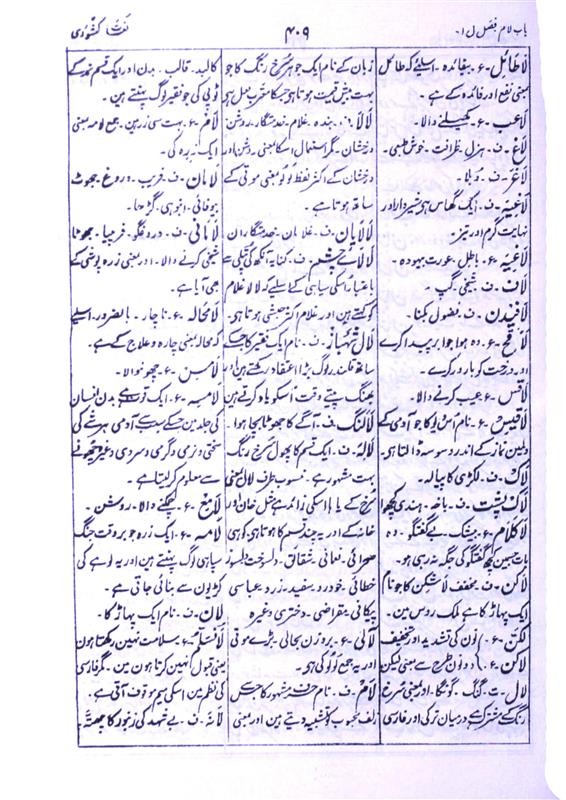
لانا लाना lānā contrac. of le-ānā, lit. 'having taken to come, or to take and come'
H لانا लाना lānā (contrac. of le-ānā, lit. 'having taken to come, or to take and come'), v.t. To bring, fetch; to bring forward, to adduce; to bring in, introduce, usher in; to import; to bring under, to include (in); to bring (a person) to agree (to, -par), to induce, persuade, win over (to); to apply; to purchase, buy; to bring forth, beget, breed, yield, produce, make (N.B.—lānā, although it governs the acc. case, is, since a neut. verb enters into its construction, treated as a neuter verb in the tenses formed by means of the perfect part.; the nom. case, and not the agent being employed; e.g. maiṅ usko lāyā hūṅ, 'I have brought him or it,' not maiṅ-ne usko lāyā hai):—lānā-bandī, s.f. Assessment of land according to the number of ploughs employed on it:—lānā lagānā, s.m. Taking cattle in lieu of money (from a debtor).
لينه līna for A. لينة līnat
P لينه līna (for A. لينة līnat), s.m. A kind of palm.
لينا लेना lenā, dialec. लैना lainā
H لينا लेना lenā, (dialec.) लैना lainā [le˚ = Prk. ले(इ)=लह(इ)=S. लभ(ते), rt. लभ्;+mī = Prk. अणअं=S. अनीयं], v.t. To take, accept, receive; to hold, grasp, lay hold of; to get, obtain, acquire; to reach; to buy, purchase; to borrow;—to absorb, consume; to take possession of, to appropriate; to seize, capture; to win; to overcome, master, conquer; to browbeat; to extort;—to take to task, to chide, rebuke, reprove;—to pick, pluck out (hair); to cut, pare (the nails);—(as a gerund), s.m. Taking, receiving, &c. (=len);—money to be realized, outstanding debt (the verb lenā is frequently annexed to the base of another verb to form intensives, and it becomes neuter itself when the leading verb is such; it is also occasionally used to form nominal verbs, e.g. kām lenā (-se), 'to take work' (from), 'to make use' (of);—mol lenā, 'to purchase'):—le-ḍālnā, v.t. To master completely; to thoroughly overpower or subdue;—to take sharply to task, to rebuke severely; to rate, scold, &c.; to disgrace, to humiliate:—le-lenā, v.t. To take, receive, &c. (=lenā); to take away (from, -se); to conquer or master completely; to take possession of, to seize upon; to take by force; to extort:—lenā-denā, s.m.=len-den, q.v.:—lenā ek na denā do, 'Nor one to receive nor two to give'; having nothing to gain or lose:—lene ānā (-ko), To come out (or forth) to receive (a person):—lene-ke dene paṛnā, 'To have to pay instead of receiving'; to be drawn into a difficulty; to be or become a loser (by);—to be on the point of death, to be past all hope.