- Index of Books 180356
-
-
Book Categories
-
Activities89
Children's Literature1978
Drama916 Education341 Essays & Profiles1362 Fiction1570 Health104 History3266Humorous592 Journalism200 Language & Literature1681 Letters729
Life Style30 Medicine972 Movements268 Novel4266 Political350 Religions4765Research & Criticism6485Short-story2661 Sketches233 Social issues109 Sufism / Mystic2006Text Books424 Translation4198Women's writings5756-
Book Categories
- Bait Bazi14
- Catalogue / Index4
- Couplets68
- Deewan1250
- Doha49
- Epics100
- Exegesis181
- Geet63
- Ghazal1256
- Haiku11
- Hamd56
- Humorous31
- Intikhab1576
- Keh mukarni6
- Kulliyat567
- Mahiya20
- Majmua4864
- Marsiya387
- Masnavi736
- Musaddas44
- Naat587
- Nazm1201
- Others84
- Paheli14
- Qasida177
- Qawwali16
- Qit'a67
- Quatrain263
- Quintuple15
- Rekhti12
- Remainders16
- Salaam34
- Sehra12
- shahr-Ashob, Hajw, Zatal Nama17
- Tareekh-Goi25
- Translation74
- Wasokht24
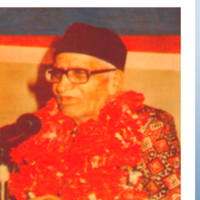
Profile of Abdul Wahid Sindhi
Identity: A children's writer, religious thinker, educationist, journalist, and an author of Sindhi and Urdu literature
Maulana Abdul Wahid Sindhi was born in 1912 in the village of Bhale Dino, in Panu Aqil (formerly part of Sukkur district), Sindh. He was orphaned at an early age, yet he continued his pursuit of education with determination. He received his early education at the well-known institution “Madrasa Qasim-ul-Uloom” in Ghotki, where he developed an interest in the English language. Later, with the support of Maulana Din Muhammad Wafai, he secured the Abdullah Haroon Scholarship and enrolled in Jamia Millia Islamia, Delhi, in 1922.
The intellectual and academic environment of Jamia played a vital role in shaping his personality. There, he had the opportunity to learn from distinguished scholars such as Maulana Muhammad Ali Johar, Dr. Muhammad Ali Bijnori, Khwaja Abdul Hai, and Dr. Zakir Husain. This environment nurtured his religious consciousness, national outlook, and a distinctive literary style that later became his hallmark.
Maulana Abdul Wahid Sindhi authored numerous books for children, among which “Islam Kaise Shuru Hua” (How Islam Began) and “Islam ke Mashhoor Sipahsalar” (Famous Commanders of Islam) gained particular popularity. He also wrote reformative stories for young readers.
A key feature of his writings is that he did not merely provide religious knowledge as information, but aimed to instill moral values such as character-building, service to humanity, patience, gratitude, sincerity, and brotherhood. He presented the teachings of the Qur’an and Islamic history in a way that was easily understandable and applicable for children.
After the partition of India, he migrated to Pakistan. Initially, his writings were published under the name “Abdul Wahid Jamai,” but later, influenced by Maulana Ubaidullah Sindhi, he adopted the name “Abdul Wahid Sindhi.”
Following the establishment of Pakistan, he rendered significant services in journalism and editorial work. On 15 November 1948, he joined the translation section of a news bulletin under the Ministry of Information as Assistant Editor. This bulletin later evolved into a literary magazine titled “Nai Zindagi”, which he edited.
The magazine “Nai Zindagi” proved to be a milestone in the history of Sindhi literature. It broke the literary stagnation that followed the creation of Pakistan and encouraged new writers. He also played a key role in promoting female writers, including Sumaira Zareen, Mehtab Mahboob, and Rasheeda Hijab.
He initiated a publication series under “Nai Zindagi” and published several significant works of Sindhi literature, including “Mehran ki Lehrain”, “Mehran ki Maujain”, “Mehran ke Moti”, and works on Shah Abdul Latif Bhittai.
Death: Maulana Abdul Wahid Sindhi passed away on 3 January 1988 in Karachi, where he was laid to rest.
USEFUL LINKS : | https://baseeratafroz.pk/article/179
Tagged Under
join rekhta family!
-
Activities89
Children's Literature1978
-