- Index of Books 180518
-
-
Book Categories
-
Activities89
Children's Literature1980
Drama917 Education342 Essays & Profiles1363 Fiction1584 Health104 History3263Humorous593 Journalism200 Language & Literature1625 Letters727
Life Style30 Medicine970 Movements267 Novel4270 Political350 Religions4762Research & Criticism6519Short-story2666 Sketches232 Social issues109 Sufism / Mystic2007Text Books423 Translation4190Women's writings5753-
Book Categories
- Bait Bazi14
- Catalogue / Index4
- Couplets68
- Deewan1248
- Doha49
- Epics100
- Exegesis181
- Geet63
- Ghazal1259
- Haiku11
- Hamd57
- Humorous31
- Intikhab1581
- Keh mukarni6
- Kulliyat571
- Mahiya20
- Majmua4872
- Marsiya387
- Masnavi737
- Musaddas44
- Naat588
- Nazm1200
- Others84
- Paheli14
- Qasida177
- Qawwali16
- Qit'a67
- Quatrain263
- Quintuple15
- Rekhti12
- Remainders16
- Salaam34
- Sehra12
- shahr-Ashob, Hajw, Zatal Nama17
- Tareekh-Goi25
- Translation74
- Wasokht24
Profile of Mahatma Gandhi
Identity: The great leader of India's independence movement, Father of the Nation, the pioneer of Non-violence (Ahimsa) and Satyagraha.
Mohandas Karamchand Gandhi (Mahatma Gandhi) was born on October 2, 1869, in Porbandar, Gujarat. His father, Karamchand Gandhi, was the Dewan of the Porbandar State, and his mother, Putlibai, was of a deeply religious nature. From childhood, he was profoundly influenced by truth, non-violence, and religious tolerance.
He received his primary education in Rajkot and went to England for higher studies, where he earned a law degree. Later, he went to South Africa to practice law, where the discrimination faced by Indians changed the course of his life. It was there that he first employed Satyagraha (non-violent resistance) and fought for civil rights.
After returning to India in 1915, Gandhi Ji emerged as a prominent leader of the Indian independence movement. He organized farmers, laborers, and the common public, leading non-violent movements against British rule. Under his leadership, historic movements such as the Champaran Satyagraha, Kheda Satyagraha, Non-Cooperation Movement, Salt Satyagraha (Dandi March, 1930), and the Quit India Movement (1942) had a nationwide impact.
Gandhi Ji emphasized not only political freedom but also social reforms. He campaigned against untouchability, advocated for women's rights, and promoted self-reliance (Swadeshi). He was a symbol of simple living, Khadi, fasting, and moral discipline.
His life was entirely based on the principles of truth and non-violence. He lived in the Sabarmati Ashram, and the general public affectionately called him "Bapu" and the "Father of the Nation."
At the time of India's independence, he was deeply saddened by the partition of the country and continuously strived for Hindu-Muslim unity.
October 2 is celebrated as Gandhi Jayanti in India and as the International Day of Non-Violence across the world.
He is counted among the most influential leaders in world history, whose ideology inspired human rights movements globally.
Death: He was assassinated by Nathuram Godse on January 30, 1948, in New Delhi.
USEFUL LINKS : | https://en.wikipedia.org/wiki/Mahatma_Gandhi
Tagged Under
join rekhta family!
-
Activities89
Children's Literature1980
-
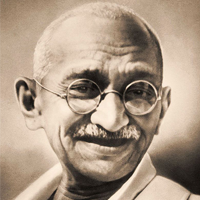
The great leader of the Indian independence movement, the Father of the Nation, and the pioneer of Non-violence and Satyagraha