- Index of Books 180586
-
-
Book Categories
-
Activities89
Children's Literature1981
Drama918 Education342 Essays & Profiles1364 Fiction1600 Health107 History3268Humorous593 Journalism200 Language & Literature1612 Letters727
Life Style30 Medicine972 Movements267 Novel4274 Political349 Religions4762Research & Criticism6522Short-story2667 Sketches232 Social issues109 Sufism / Mystic2007Text Books423 Translation4190Women's writings5753-
Book Categories
- Bait Bazi14
- Catalogue / Index4
- Couplets68
- Deewan1248
- Doha49
- Epics100
- Exegesis181
- Geet63
- Ghazal1259
- Haiku11
- Hamd58
- Humorous31
- Intikhab1581
- Keh mukarni6
- Kulliyat571
- Mahiya20
- Majmua4874
- Marsiya387
- Masnavi737
- Musaddas44
- Naat589
- Nazm1201
- Others84
- Paheli14
- Qasida178
- Qawwali16
- Qit'a67
- Quatrain263
- Quintuple15
- Rekhti12
- Remainders16
- Salaam34
- Sehra12
- shahr-Ashob, Hajw, Zatal Nama17
- Tareekh-Goi25
- Translation74
- Wasokht24
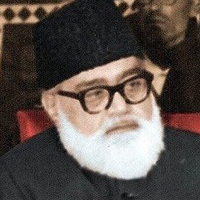
Profile of Maulana Abul Aala Maududi
Real Name : Sayyad Abul Aala Maududi
Born : 25 Sep 1903 | Aurangabad, Maharashtra
Identity: Islamic thinker, Qur’anic exegete, journalist, author, founder of Jamaat-e-Islami
Syed Abul A‘la Maududi is counted among the great Islamic thinkers of the Indian subcontinent who rendered wide-ranging and significant services to Islamic thought, religious consciousness, and the revival of Islam in the twentieth century. He belonged to a religious and scholarly family. Among his ancestors was Khwaja Qutbuddin Maudud Chishti, who was the chief disciple of Khwaja Moinuddin Chishti of Ajmer. Owing to this lineage, the family came to be known as Maududi.
Maulana Maududi received his early education and training at home under the supervision of his father. For the first eleven years, he studied religious as well as modern subjects entirely in a home environment. Later, he was admitted directly to the eighth grade at Madrasa Furqania, Aurangabad. In 1914, he successfully passed the examination of Maulvi. Around the same time, his family moved to Hyderabad, where he was enrolled in the Aalim class at Darul Uloom. At that time, the head of the institution was Hamiduddin Farahi. However, due to his father’s death, Maulana Maududi could continue his formal studies there for only six months.
Allah had endowed Maulana Maududi with exceptional writing ability. He therefore chose the pen as his means of expression as well as livelihood and began his professional life as a journalist. He served as editor of several newspapers, most notably Madina (Bijnor), Taj (Jabalpur), and the daily Al-Jamiat (Al-Hamiyat) published by Jamiat Ulema-e-Hind in Delhi. In 1925, when Jamiat Ulema-e-Hind decided to cooperate with the Indian National Congress, Maulana Maududi resigned from the editorship of Al-Hamiyat as a matter of principle.
Maulana Maududi was a highly prolific author. He wrote dozens of books on the Qur’an, Hadith, jurisprudence, politics, economics, civilization, ethics, and contemporary issues. His renowned work Tafheem-ul-Qur’an (6 volumes) holds a distinguished place in the tradition of Qur’anic exegesis. His other important works include Tafheemat, Rasail-o-Masail, Seerat-e-Sarwar-e-Aalam (PBUH), Purdah, Al-Jihad fi al-Islam, Khilafat aur Mulukiyat, Sood, Ma‘ashiyat-e-Islam, Islami Siyasat, Islami Tahzeeb aur Uske Usool-o-Mabadi, The Constitutional Status of Sunnah, Tajdeed-o-Ihya-e-Deen, and The Four Basic Qur’anic Terms. His writings gave new intellectual directions not only in the subcontinent but throughout the Muslim world.
Maulana Maududi devoted his entire life to the revival and renewal of Islam. As a conscious and reflective thinker, he critically examined history, politics, and civilization, and laid the foundation of Jamaat-e-Islami as a practical manifestation of his intellectual struggle. One may differ with his ideas, but it is not possible to ignore them. He wrote on almost every aspect of life and consistently expressed his views on education, politics, society, and religious thought.
Maulana Maududi passed away on 22 September 1979 in Buffalo, New York (USA), where he had gone for medical treatment. He was later laid to rest at his residence in Ichhra, Lahore.
USEFUL LINKS : | https://ur.wikipedia.org/wiki/%D8%A7%D8%A8%D9%88_%D8%A7%D9%84%D8%A7%D8%B9%D9%84%DB%8C_%D9%85%D9%88%D8%AF%D9%88%D8%AF%DB%8C
join rekhta family!
-
Activities89
Children's Literature1981
-