- Index of Books 180695
-
-
Book Categories
-
Activities89
Children's Literature1989
Drama921 Education347 Essays & Profiles1376 Fiction1655 Health108 History3343Humorous603 Journalism201 Language & Literature1141
Letters724 Life Style30 Medicine974 Movements268 Novel4275 Political349 Religions4769Research & Criticism6695Short-story2671 Sketches237 Social issues111 Sufism / Mystic2014Text Books440 Translation4185-
Book Categories
- Bait Bazi14
- Catalogue / Index4
- Couplets70
- Deewan1254
- Doha50
- Epics99
- Exegesis186
- Geet63
- Ghazal1263
- Haiku11
- Hamd59
- Humorous31
- Intikhab1582
- Keh mukarni6
- Kulliyat571
- Mahiya20
- Majmua4874
- Marsiya386
- Masnavi736
- Musaddas44
- Naat590
- Nazm1209
- Others84
- Paheli14
- Qasida179
- Qawwali16
- Qit'a67
- Quatrain264
- Quintuple15
- Rekhti12
- Remainders16
- Salaam34
- Sehra12
- shahr-Ashob, Hajw, Zatal Nama17
- Tareekh-Goi26
- Translation75
- Wasokht24
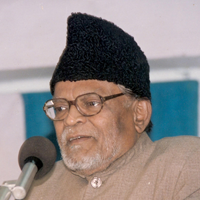
Profile of Nisar Ahmed Faruqi
Identity: Researcher, Scholar of Sufism, Teacher of Arabic Language and Literature, and a Distinguished Authority on Sufi Studies in South Asia
Nisar Ahmad Faruqi was born on 29 June 1934 in Amroha, Uttar Pradesh. His father was Tasleem Ahmad Faruqi and his mother was Maimoona Khatoon. He received his early education at home under the guidance of his maternal grandfather and uncle, where he acquired a strong foundation in Arabic, Persian, Urdu, and Islamic studies. He later studied in Hyderabad and Aligarh, earned an M.A. in Arabic, and obtained a Ph.D. from the University of Delhi on the subject of Early Muslim Historiography.
He began his teaching career at the University of Delhi in 1964. Later, he served as a lecturer in Arabic at Delhi College, became Reader in Modern Arabic at the University of Delhi in 1977, and was appointed Professor and Head of the Department of Arabic in 1985. He retired from academic service in 2002.
Nisar Ahmad Faruqi is regarded as one of the leading researchers, scholars of Sufism, and distinguished intellectual figures of Urdu studies in South Asia. He made significant contributions to the fields of Sufism, Islamic history, Arabic and Persian literature, and Urdu research. Besides Arabic, Persian, Urdu, Hindi, and English, he was also well acquainted with Punjabi.
Among his notable works are Talash-e-Mir and Talash-e-Ghalib. He compiled Ghalib Ki Aap Beeti (Ghalib’s Autobiography) based on Ghalib’s letters and translated Zikr-e-Mir into Urdu. He also edited and prepared critical editions of Kulliyat-e-Mushafi, Qudratullah Shauq’s biographical anthology Tabaqat al-Shu‘ara, and Qiyamuddin’s Maqalat al-Shu‘ara. In addition, he produced numerous translations, annotations, critical editions, and scholarly commentaries. His research on Sufism and Sufi saints is particularly valued, while Maqalat-e-Faruqi is regarded as an important reflection of his scholarly insight.
Death: Nisar Ahmad Faruqi passed away on 28 November 2004 in New Delhi and was laid to rest in his ancestral graveyard in Amroha, Uttar Pradesh.
USEFUL LINKS : | https://en.wikipedia.org/wiki/Nisar_Ahmed_Faruqi
join rekhta family!
-
Activities89
Children's Literature1989
-