- Index of Books 180576
-
-
Book Categories
-
Activities91
Children's Literature1979
Drama915 Education341 Essays & Profiles1362 Fiction1568 Health104 History3280Humorous597 Journalism200 Language & Literature1691 Letters733
Life Style30 Medicine972 Movements269 Novel4268 Political350 Religions4764Research & Criticism6503Short-story2662 Sketches233 Social issues109 Sufism / Mystic2009Text Books433 Translation4211Women's writings5765-
Book Categories
- Bait Bazi14
- Catalogue / Index4
- Couplets68
- Deewan1253
- Doha49
- Epics100
- Exegesis181
- Geet63
- Ghazal1258
- Haiku11
- Hamd56
- Humorous31
- Intikhab1572
- Keh mukarni6
- Kulliyat568
- Mahiya20
- Majmua4857
- Marsiya387
- Masnavi737
- Musaddas44
- Naat586
- Nazm1205
- Others84
- Paheli14
- Qasida178
- Qawwali16
- Qit'a67
- Quatrain264
- Quintuple15
- Rekhti12
- Remainders16
- Salaam34
- Sehra12
- shahr-Ashob, Hajw, Zatal Nama17
- Tareekh-Goi25
- Translation74
- Wasokht24
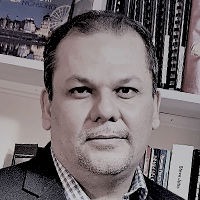
Profile of Asghar Mehdi Ashar
Across the vast landscape of Urdu literature, few contemporary figures have contributed as extensively, as systematically, and as innovatively to a single genre as Asghar Mehdi Ashar has to marsiya. In an era where classical literary forms struggle for survival, Ashar has emerged as a singular force — a scholar, lexicographer, editor, digital archivist, and reciter whose work has reshaped the modern understanding and preservation of marsiya.
Born on 12 October 1973 in Karachi, and now based in Canada, Ashar stands at the intersection of tradition and technology. His contributions span digital preservation, lexicography, critical editing, recitation, and organizational leadership, forming one of the most significant modern bodies of work in marsiya studies.
Early Life and Intellectual Formation
Ashar’s connection to marsiya is deeply rooted in family heritage. His father, Syed Muhammad Jafar Rizvi, was a Teht‑ul‑Lafz reciter from Zaidpur, Barabanki — a region historically associated with classical marsiya khwani. His mother, Shaukat Ara Begum, was a marsiya khwan from Wazirganj, Lucknow, the cultural heartland of marsiya.
This dual lineage — Barabanki’s precision and Lucknow’s elegance — shaped Ashar’s sensibilities from childhood. While he pursued engineering academically, earning a Mechanical Engineering degree from NED University and an Executive MBA from the University of Waterloo, his literary pursuits continued to deepen. The analytical rigor of engineering and the emotional depth of marsiya fused into a unique intellectual identity that would later define his scholarly work.
Digital Preservation: The eMarsiya Revolution
Ashar’s most transformative contribution is eMarsiya.com, the world’s largest digital archive dedicated to marsiya literature. The platform includes:
Thousands of marsiyas
Hundreds of poets
Rare manuscripts
Audio and video recitations
Critical editions
Lexicons and reference works
He is also the first person to coin and popularize the term “eMarsiya.”
In 2025, the University of Texas at Austin invited him to deliver a lecture on the digital renaissance of marsiya — a recognition of his pioneering role in preserving classical literature through modern technology.
Lexicography: The Largest Modern Dictionary Project in Marsiya Studies
Ashar’s lexicographical work is unprecedented in scope. His dictionaries collectively form the largest modern lexicon project dedicated to marsiya and its major poets.
Published Lexicons
Farhang‑e‑Anees (Urdu Dictionary Board, Pakistan)
Farhang‑e‑Dabeer
Farhang‑e‑Josh
Completed / In Progress / To Be Published
Farhang‑e‑Mounis (To be published by Urdu Dictionary Board)
Farhang‑e‑Anees o Dabeer (To be published by Urdu Dictionary Board)
Farhang‑e‑Marsiya — 5 Volumes (To be published by Urdu Dictionary Board)
Farhang‑e‑Marsiya (5 Volumes) is one of the most ambitious lexicographical undertakings in Urdu literature — a comprehensive dictionary covering the entire marsiya tradition across poets, eras, and linguistic registers.
Critical Editions and Compilations: A Monumental Editorial Corpus
Ashar has produced the largest modern critical edition series of marsiya poetry.
A. Mirza Dabeer’s Marsiyas (9 Volumes)
Published
Dabeer ke Marsiye — Jild 1
Dabeer ke Marsiye — Jild 2
Dabeer ke Marsiye — Jild 3
Dabeer ke Marsiye — Jild 4
Dabeer ke Marsiye — Jild 5
Dabeer ke Marsiye — Jild 6
Dabeer ke Marsiye — Jild 7
Forthcoming
Dabeer ke Marsiye — Jild 8 (To be published soon)
Dabeer ke Marsiye — Jild 9 (To be published soon)
This nine‑volume project is the most extensive editorial work on Dabeer in over a century.
B. Mounis’s Marsiyas
Mounis ke Marsiye — Jild 1
Mounis ke Marsiye — Jild 2 (To be published)
Mounis ke Marsiye — Jild 3 (To be published)
C. Other Poets
Sagheer Sonwi ke Marsiye
Abr Jonpuri ke Marsiye
Research Works, Monographs & Foundational Texts
Farogh‑e‑Marsiya — Aik Naye Azm ki Ibteda
Ishariya‑e‑Dabeer (To be published)
These works provide critical frameworks for understanding marsiya’s evolution, themes, and linguistic structures.
Farogh‑e‑Marsiya International: A Global Literary Movement
As founder of Farogh‑e‑Marsiya International, Ashar has built one of the most active marsiya‑focused literary organizations in the world.
Farogh‑e‑Marsiya Shumare (Issues 1–23)
A continuous scholarly series documenting research, criticism, archival material, and global marsiya activity.
Total Publications to Date: 45
This makes Farogh‑e‑Marsiya International one of the most prolific marsiya‑focused organizations globally.
National Recognition by the Urdu Dictionary Board
During his most recent visit to Pakistan, the Urdu Dictionary Board (Government of Pakistan) held a formal recognition ceremony in his honor. The event celebrated:
His lexicons (Farhang‑e‑Anees, Farhang‑e‑Dabeer, upcoming Farhang‑e‑Marsiya)
His contribution to Urdu lexicography
His role in preserving classical literature
His global impact on marsiya scholarship
This recognition places him among the very few contemporary scholars formally honored by Pakistan’s national linguistic institutions.
Teht‑ul‑Lafz Marsiya Khwani: A Classical Voice in a Modern Age
Ashar’s recitation style is defined by:
Word‑perfect clarity
Meter‑perfect delivery
Research‑based pausing
Zero dramatization
Classical dignity
He has recorded numerous marsiyas and released multiple volumes in Pakistan and India, preserving the authentic Teht‑ul‑Lafz tradition.
Conclusion: A Scholar for the Ages
With 45 publications, multiple lexicons, nine‑volume critical editions, digital archives, and a global literary movement, Asghar Mehdi Ashar stands as one of the most significant modern contributors to marsiya literature.
His work bridges centuries — honoring the past, enriching the present, and safeguarding the future of one of Urdu’s greatest literary traditions.aTagged Under
join rekhta family!
-
Activities91
Children's Literature1979
-