- Index of Books 180767
-
-
Book Categories
-
Activities90
Children's Literature1990
Drama923 Education347 Essays & Profiles1375 Fiction1656 Health108 History3352Humorous603 Journalism202 Language & Literature1142
Letters725 Life Style30 Medicine975 Movements268 Novel4284 Political349 Religions4779Research & Criticism6708Short-story2672 Sketches237 Social issues111 Sufism / Mystic2017Text Books441 Translation4197-
Book Categories
- Bait Bazi14
- Catalogue / Index4
- Couplets70
- Deewan1254
- Doha50
- Epics99
- Exegesis186
- Geet63
- Ghazal1269
- Haiku11
- Hamd61
- Humorous31
- Intikhab1583
- Keh mukarni6
- Kulliyat571
- Mahiya20
- Majmua4886
- Marsiya387
- Masnavi737
- Musaddas44
- Naat592
- Nazm1214
- Others84
- Paheli14
- Qasida179
- Qawwali16
- Qit'a68
- Quatrain264
- Quintuple15
- Rekhti12
- Remainders16
- Salaam34
- Sehra12
- shahr-Ashob, Hajw, Zatal Nama17
- Tareekh-Goi26
- Translation75
- Wasokht24
Profile of Ibn-e-Sina
Identity: Abu Ali al-Husayn ibn Abd Allah ibn Sina (known in the West as Avicenna), titled "Al-Shaykh al-Ra'is," the prominent physician of the Islamic world, philosopher, polymath, and the "Sun of the Medical World."
Ibn Sina (Abu Ali Husayn ibn Abd Allah ibn al-Hasan ibn Ali ibn Sina) is considered the most significant thinker, philosopher, physician, and man of letters of the Islamic Golden Age. It is due to the linguistic resonance of his name that drugs are referred to as 'Medicine' today. He was born in Safar 370 AH (980 AD) in the Persian village of "Afshana" and moved to Bukhara with his parents during childhood. By the age of just 10, he completed the Quran and gained mastery in jurisprudence, literature, philosophy, and medical sciences. At the young age of 18, he cured Sultan Nuh ibn Mansur of Bukhara of an incurable disease that had baffled all other physicians, in return for which he was granted access to the Royal Library. He spent most of his life traveling through Bukhara, Khwarezm, Gorgan, Ray, and Hamadan, and was also associated with the court of Ala al-Dawla in Isfahan.
His scholarly contributions span from medicine and philosophy to astronomy, chemistry, mathematics, music, and poetry. He authored approximately 450 books, of which 240 have survived (150 on philosophy and 40 on medicine). His world-renowned work, "Al-Qanun fi al-Tibb" (The Canon of Medicine), is a medical encyclopedia that remained the standard of teaching in European universities until the late 19th century and was republished in New York in 1973. "Kitab al-Shifa" (The Book of Healing) is his second major scientific and philosophical masterpiece. Works like 'Risala al-Zawiya' and 'Mukhtasar Uqlidus' in mathematics, 'Risala fi al-Faza' in physics, and 'Maqala Jawami' Ilm al-Musiqi' in music stand as testimonies to his intellectual brilliance.
In Europe, Ibn Sina is held in immense respect, and American novelist Noah Gordon wrote the famous novel 'The Physician' based on his life, which was also adapted into a film in 2013. In the final days of his life, he suffered from colic, and sensing his end was near, he repented, gave away his wealth in charity, and emancipated his slaves.
Death: He passed away in Shaban 427 AH (1037 AD) in Hamadan (Iran) and is buried there.
USEFUL LINKS : | https://en.wikipedia.org/wiki/Avicenna | https://en.wikipedia.org/wiki/Avicenna
Tagged Under
join rekhta family!
-
Activities90
Children's Literature1990
-
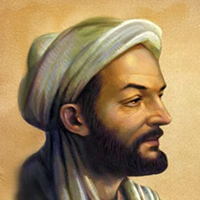
Eminent philosopher, polymath personality, and a brilliant sun of the medical world
Eminent philosopher, polymath personality, and a brilliant sun of the medical world