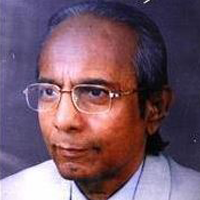

Professor Wahab Ashrafi passed away on 15 July 2012 in Patna.
- Index of Books 180433
-
-
Book Categories
-
Activities89
Children's Literature1979
Drama917 Education341 Essays & Profiles1360 Fiction1568 Health104 History3265Humorous593 Journalism200 Language & Literature1625 Letters726
Life Style30 Medicine969 Movements268 Novel4268 Political350 Religions4763Research & Criticism6515Short-story2665 Sketches232 Social issues109 Sufism / Mystic2007Text Books424 Translation4193Women's writings5755-
Book Categories
- Bait Bazi14
- Catalogue / Index4
- Couplets68
- Deewan1248
- Doha49
- Epics100
- Exegesis181
- Geet63
- Ghazal1258
- Haiku11
- Hamd57
- Humorous31
- Intikhab1578
- Keh mukarni6
- Kulliyat571
- Mahiya20
- Majmua4865
- Marsiya387
- Masnavi737
- Musaddas44
- Naat588
- Nazm1201
- Others84
- Paheli14
- Qasida177
- Qawwali16
- Qit'a67
- Quatrain263
- Quintuple15
- Rekhti12
- Remainders16
- Salaam34
- Sehra12
- shahr-Ashob, Hajw, Zatal Nama17
- Tareekh-Goi25
- Translation74
- Wasokht24
Profile of Wahaab Ashrafi
Identity: Researcher, Critic, Journalist, Historian, Short Story Writer
Professor Wahab Ashrafi was born in Bibipur (Kako), a town in Jehanabad district (formerly part of Gaya), Bihar. Although there has been some difference of opinion regarding his date of birth, his high school certificate records it as 2 June 1936, a date he himself accepted as correct. The region has long been known as an important center of learning and spirituality, and the shrine of the revered saint Bibi Kamalo also adds to its significance.
Wahab Ashrafi was a versatile and towering figure in Urdu literature. His deep association with literature is evident from the fact that he was simultaneously a researcher, an outstanding critic, a journalist, a historian, a teacher, and a short story writer. Among those who gave new intellectual directions to Urdu criticism after India’s independence, his name occupies a prominent place. Without aligning himself formally with any particular school of thought or ideology, he adopted an independent, broad-minded, and balanced critical approach, which became his distinctive feature.
He began his professional career in journalism. During his stay in Calcutta, he was associated with newspapers such as Asr-e-Jadeed, Al-Haq, and Akhuwat, and also contributed to journals like Aahang and Morcha published from Gaya. Later, he served as the editor of the magazine Sanam, which gained wide recognition within a short period. The quarterly journal Mubahitha, published from Patna under his editorship, continued until the last days of his life and emerged as an effective platform for young writers and poets.
Wahab Ashrafi initially showed interest in poetry, later turning towards short story writing. He wrote nearly 42 short stories, and two collections of his stories were published. However, he soon devoted himself primarily to literary criticism, which became his main field of recognition. His first critical book, Qutb-e-Mushtari: A Critical Study (1967), was followed by important works such as Qadeem Adabi Tanqeed (1973), Masnaviyat-e-Mir ka Tanqeedi Jayeza (1981), and Masnavi aur Masnaviyat.
His collections of critical essays include Ma‘ni ki Talash, Aagahi ka Manzar-Nama, Urdu Fiction aur Teesri Aankh, Harf Harf Aashna, Ma‘ni se Musafaha, Ma‘ni ki Jiblat, and Ma‘ni ka Masla, which discuss major issues related to classical and modern literature, fiction, poetry, and criticism. In addition, books such as Mashriqi aur Maghribi Tanqeed, Marxist Philosophy and Socialism, and Idrak-e-Ma‘ni aur Pas-e-Aaina significantly expanded the intellectual scope of Urdu criticism.
In the field of research and encyclopedic writing, his most outstanding achievement is the seven-volume work Tarikh-e-Adabiyat-e-Aalam (1991–2005), which presents a comprehensive survey of world literature in major languages. This was followed by the three-volume Tarikh-e-Adab-e-Urdu (2007), regarded as the most up-to-date and authoritative history of Urdu literature, for which he received the Sahitya Akademi Award.
In the genre of autobiography, his work Qissa Be-Samt Zindagi Ka holds special importance. His books written for students—Kahani ke Roop, Nuqoosh-e-Adab, and Tafheem-e-Balaghat—along with his textbooks, clearly reflect his deep pedagogical insight.
Tagged Under
join rekhta family!
-
Activities89
Children's Literature1979
-