- Index of Books 180318
-
-
Book Categories
-
Activities89
Children's Literature1978
Drama916 Education341 Essays & Profiles1360 Fiction1569 Health104 History3261Humorous592 Journalism200 Language & Literature1677 Letters726
Life Style30 Medicine969 Movements268 Novel4263 Political350 Religions4761Research & Criticism6488Short-story2661 Sketches233 Social issues109 Sufism / Mystic2007Text Books424 Translation4194Women's writings5756-
Book Categories
- Bait Bazi14
- Catalogue / Index4
- Couplets68
- Deewan1247
- Doha49
- Epics100
- Exegesis181
- Geet63
- Ghazal1256
- Haiku11
- Hamd57
- Humorous31
- Intikhab1578
- Keh mukarni6
- Kulliyat571
- Mahiya20
- Majmua4861
- Marsiya387
- Masnavi737
- Musaddas44
- Naat587
- Nazm1200
- Others84
- Paheli14
- Qasida177
- Qawwali16
- Qit'a67
- Quatrain263
- Quintuple15
- Rekhti12
- Remainders16
- Salaam34
- Sehra12
- shahr-Ashob, Hajw, Zatal Nama17
- Tareekh-Goi25
- Translation74
- Wasokht24
Profile of Ibn Khaldun
Identity: Historian, Founding Father of Sociology, Philosopher, Economist, and Author of "The Muqaddimah."
Abu Zayd Wali al-Din Abd al-Rahman ibn Muhammad ibn Khaldun al-Hadrami, universally known as Ibn Khaldun, was born in 732 AH / 1332 AD in Tunis to a distinguished Andalusian Arab family. His family originally belonged to Al-Andalus (Spain) and later migrated to North Africa. He received his early education under the guidance of his father and the prominent scholars of that era, studying the Quran, Hadith, Fiqh (jurisprudence), Arabic language, literature, logic, and philosophy.
Ibn Khaldun is revered as a monumental Muslim polymath, philosopher of history, and the true founding father of modern Sociology. He revolutionized historiography by systematically separating myths and irrational folklore from authentic historical events, becoming the first thinker to apply a rigorous scientific method to the study of social phenomena.
Ibn Khaldun's practical life was characterized by immense political turbulence, court intrigues, and continuous migration. He served as a scribe, vizier, and diplomat across the royal courts of Tunis, Fez (Morocco), and Granada (Spain), while also enduring periods of imprisonment due to political rivalries. Seeking refuge from political chaos, he retreated into a four-year scientific reclusion at Qal'at Ibn Salama (Algeria), where he penned his timeless masterpiece. Later in life, he migrated to Egypt, where he served as the Grand Maliki Qadi (Chief Justice) and famously negotiated with the fierce world conqueror Tamerlane (Timur) during the siege of Damascus, successfully acting as a mediator to prevent bloodshed.
The philosophical works of Ibn Khaldun profoundly reshaped global intellectual history. His greatest academic achievement remains his universal history titled Kitab al-Ibar (History of Ibn Khaldun). Its iconic preface, The Muqaddimah, is universally celebrated as a foundational document of modern social sciences. In this text, he introduced the cyclical theory of the rise and fall of civilizations based on the concept of Asabiyyah (social cohesion). He also holds the unique distinction of being the first historian to write a detailed autobiography. Centuries later, his groundbreaking theories were embraced by Western intellectuals following Jacobus Golius's 1636 study Rhylat Ibn Khaldun, leading to its translations into Latin, French, and Greek, thereby gaining global recognition.
Death: Ibn Khaldun passed away in 808 AH / 1406 AD in Cairo, Egypt.
USEFUL LINKS : | https://en.wikipedia.org/wiki/Ibn_Khaldun
Tagged Under
join rekhta family!
-
Activities89
Children's Literature1978
-
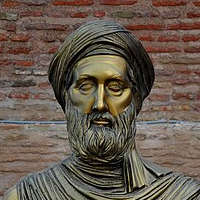
Renowned historian, founding father of sociology, and author of 'The Muqaddimah'
Renowned historian, founding father of sociology, and author of 'The Muqaddimah'